Nvidia's $750B Meltdown: What Comes Next
Jensen Huang is out, $750B in market cap is gone, and Nvidia's Nov. 17 earnings are now the most consequential print in semiconductors. Here's what traders need to know.
Key Points
- Nvidia has shed approximately $750 billion in market capitalization since the Jensen Huang scandal broke, with shares closing Thursday at $166.19 — a 52-week low that pushed the stock below a $4 trillion total market cap.
- The governance vacuum, a DOJ antitrust subpoena now extended to third parties, and a federal shareholder class-action have compounded what began as a personal scandal into a structural re-rating event.
- Nvidia's November 17 Q3 earnings — the first print under interim CEO Colette Kress — will be the definitive pressure test for whether the market separates AI compute demand from Nvidia-specific governance risk.
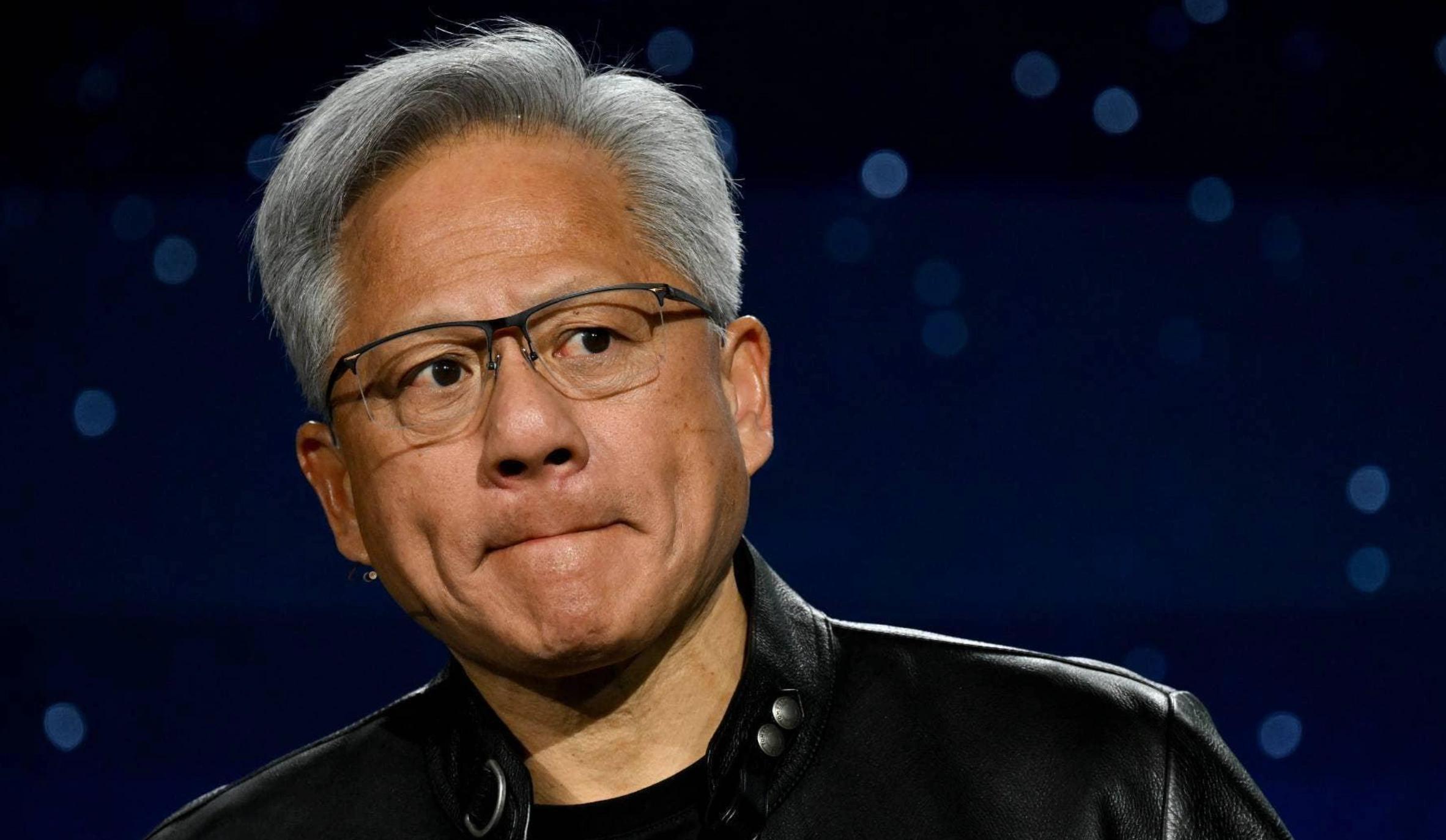
Nvidia closed Thursday at $166.19, down 4.34% on the session, capping a week in which the world's most valuable semiconductor company lost roughly $750 billion in market capitalization, hit a 52-week low, and watched its founder-CEO of 33 years resign amid a scandal linking him to an alleged Chinese intelligence asset. The stock opened down as much as 14% Wednesday before buyers stepped in; retail demand trimmed losses, but the damage to institutional confidence is not so easily papered over. Earnings land November 17. Every number on that call now carries double the weight it did two weeks ago.
The Anatomy of the Collapse
Jensen Huang's resignation was not a surprise to anyone who had followed the story intraday on Wednesday, but the scale of the market reaction still shocked. At the open, Nvidia shed roughly 14% of its value in minutes — a drawdown that, at Nvidia's size, equates to hundreds of billions of dollars in a single session. By the close, stabilization had set in, with the stock settling at a 4.34% decline to $166.19. That partial recovery is instructive: it tells you the market is not pricing in an existential collapse of Nvidia's business, but it is demanding a significant and sustained governance discount.
The scandal's specifics matter for traders precisely because they create legal and regulatory surface area that will not resolve quickly. Alice Huang, described as a former executive at Singapore-based Megaspeed — Nvidia's primary business partner in Southeast Asia — is the alleged Chinese intelligence asset at the center of the affair. The relationship between Megaspeed and Nvidia is not incidental. Southeast Asia has been a critical corridor for AI chip distribution, and any suggestion that sensitive commercial or technical information moved through that channel will fuel both the DOJ probe and the shareholder litigation for months. The Rosen Law Firm's class-action, filed in federal court in San Jose, specifically alleges that Huang and Nvidia made materially misleading statements that "artificially inflated" the stock price — language that sets up a damages calculation tied directly to the gap between Nvidia's pre-scandal highs and wherever the stock ultimately settles.
The Off-Balance-Sheet Problem Nobody Was Watching
The scandal cracked open a line of scrutiny that was already building beneath the surface. Nvidia's off-balance-sheet commitments have ballooned from $50.9 billion to $530.5 billion in just six quarters — a tenfold expansion that critics are now characterizing as a circular revenue structure in which capital flows out as equity investments and returns as customer revenue. Under normal conditions, that kind of financial engineering gets scrutinized in an analyst note. Under current conditions, with a DOJ antitrust investigation that has now extended subpoenas to third-party companies, it becomes exhibit material.
The P/E multiple reflects this uncertainty in real time. Nvidia's price-to-earnings ratio has hit a 14-year low, a remarkable compression for a company that was trading at triple-digit multiples as recently as early 2026. Bulls will correctly point out that retail buyers stepped into Wednesday's intraday trough — a sign that the brand retains enormous consumer and investor loyalty. Wolfe Research analyst Chris Caso framed it on CNBC as "sort of like the Apple Steve Jobs moment," noting that Nvidia's product roadmap is sold out through the end of 2027 and that interim CEO Colette Kress, as CFO, knows the financial architecture of the company better than almost anyone alive. That argument has merit. It does not, however, address the governance discount, the legal exposure, or the possibility that the DOJ's subpoena campaign uncovers something in those off-balance-sheet structures that changes the revenue narrative entirely.
Who Is Winning While Nvidia Burns
The clearest immediate beneficiary is AMD, which surged 5.86% to $585.30 on Wednesday even as the Nasdaq Composite fell 0.39%. That is not coincidence. AMD's MI450X, its sixth-generation AI GPU packing 288GB of HBM4 memory, launched this week alongside a new 6th-gen EPYC server lineup — timing that, intentional or not, positions AMD as the ready alternative at exactly the moment when enterprise customers are asking uncomfortable questions about supply-chain security and vendor concentration. Floodlines Research investment strategist Anna Wu was direct: "AMD as a direct competitor, and Alphabet and Broadcom in the TPU space, are natural beneficiaries in the short term." Broadcom confirmed that thesis Thursday, rising 5.54% to $364.36.
The espionage dimension is also accelerating a structural shift in procurement thinking. Reuters reported this week that AI, chip, and technology companies are actively recruiting former intelligence operatives to audit supply-chain relationships — a response that, once institutionalized, will raise switching costs away from any vendor with geopolitical exposure in its partner network. Samsung's deepening ties with AMD and SK Hynix's position as Nvidia's primary HBM supplier both become more strategically significant in this context. If enterprise customers begin diversifying away from Nvidia on security grounds rather than purely technical ones, the rotation trade in AMD and AVGO is not just a momentum play — it has a structural thesis behind it.
Nvidia's November 17 earnings call under Colette Kress is the event that sets the near-term floor or confirms the breakdown. If Kress can deliver a clean quarter, provide granular disclosure on the off-balance-sheet commitments, and offer a credible timeline for a permanent CEO search, $166 may prove to be the capitulation print. If the call surfaces additional legal disclosures, revenue restatement risk, or further DOJ developments, the stock has no technical support until the mid-$140s. Watch $160 as the line in the sand into the print — a close below that level before Monday's open would signal that institutional sellers are not waiting for answers.
The Weekly Investor
Daily market analysis for active traders. Free.