Nvidia Freefall: Jensen Out, $490B Gone, Six Downgrades
Jensen Huang resigns amid spy scandal. Nvidia sheds $490B in market cap, six firms downgrade, and earnings hit Tuesday. Here's what traders must know.
Key Points
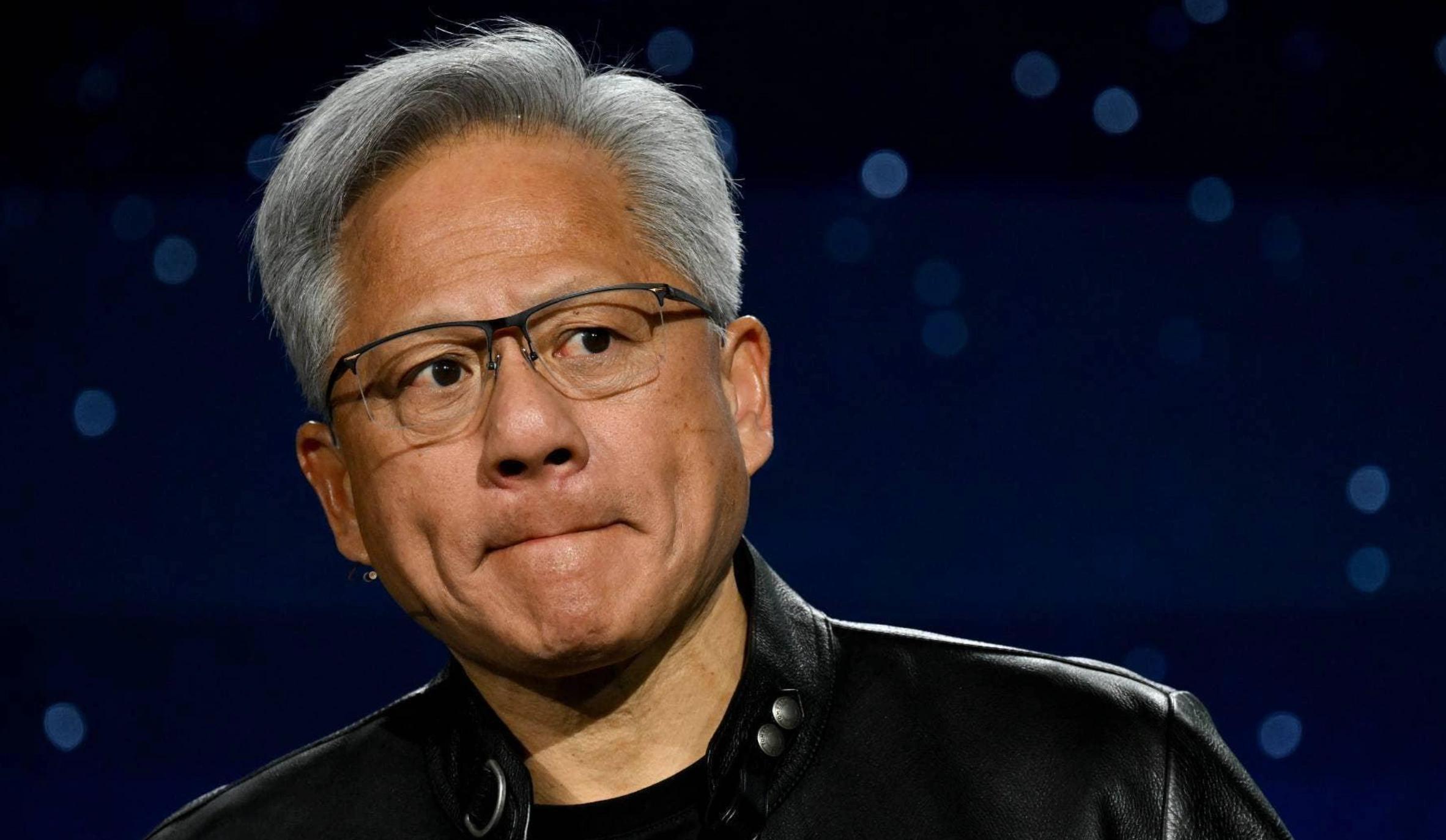
- Nvidia shed $490 billion in market cap Thursday after Jensen Huang immediately stepped down as CEO and board member amid U.S. intelligence concerns about a romantic relationship with a suspected Chinese spy.
- Six analyst firms downgraded or slashed price targets in under 48 hours — Truist cut to Hold with a $174 target from $346, Bernstein halved its target to $200, and AMD surged 5%-plus as capital rotated hard out of NVDA.
- With no permanent CEO named and earnings confirmed for Tuesday, November 17, implied volatility is set to spike — the $174–$200 downgrade cluster defines the new bear case floor traders are pricing against.
Nvidia stock dropped as much as 14% at Thursday's open — erasing $490 billion in market value in a single session — after Jensen Huang announced his immediate resignation as CEO and board member following revelations that U.S. intelligence agencies believe his romantic partner is a Chinese spy. The stock clawed back more than half its intraday losses but still closed down 4.34%, leaving it on course for its sixth consecutive weekly decline, the longest losing streak since 2012. CFO Colette Kress has been named interim CEO with no timeline given for a permanent appointment.
The Scandal Behind the Selloff
The circumstances of Huang's exit are without precedent in the semiconductor industry. This was not a planned retirement or a health-related departure — Huang was pushed out the same day the news broke, a speed that signals the board had little warning and less negotiating room. The intelligence community's characterization of his partner as a suspected Chinese spy lands Nvidia squarely at the intersection of its two biggest structural vulnerabilities: U.S.-China chip export restrictions and the credibility of its executive leadership at the most consequential moment in AI hardware history.
That combination is what drove the analyst response from cautious to panicked inside 48 hours. Six firms downgraded or issued major price target cuts in the immediate aftermath. Truist was the most aggressive, downgrading NVDA to Hold and slashing its price target to $174 from $346 — a 50% haircut. Bernstein made the same percentage cut, moving from $400 to $200. D.A. Davidson's Gil Luria, one of the more bullish voices on the street, lowered his target to $200 from $300 but held his Buy rating — a signal that the fundamental AI demand thesis isn't dead, but the leadership risk premium is now substantial and unquantifiable. Melius Research also downgraded to Hold. The cumulative analyst consensus shift represents a de-rating of Nvidia's leadership multiple that the market has not seen since its near-bankruptcy era.
What Kress Inherits — and What She Doesn't
Colette Kress steps into the interim role with one undeniable advantage: she knows the numbers cold. As CFO since 2013, she has shepherded Nvidia through its data center pivot, the crypto boom-and-bust cycles, the ARM acquisition attempt, and the explosive AI buildout that took the company from a $300 billion market cap to over $3 trillion at its peak. She is not an outsider. But she is also not Jensen Huang, and that distinction matters in ways that balance sheets cannot capture.
Huang was Nvidia's singular product visionary and its most effective salesman. His relationships with hyperscaler CEOs, sovereign AI customers, and chip architects were personal as much as commercial. Kress inherits the revenue engine — Q4 earnings, confirmed for Tuesday, November 17, are expected to show another record quarter — but she does not inherit the trust network Huang spent 30 years building. The board's challenge is speed: every week without a named permanent CEO is another week of management uncertainty layered on top of an already hostile export environment. The Biden and subsequent administrations' tightening of chip export curbs to China has already capped Nvidia's addressable market in the world's second-largest economy. The spy scandal makes it politically impossible for any near-term administration to loosen those restrictions, regardless of business rationale.
The AMD Trade Is Live — But Read the Fine Print
The immediate capital rotation tells the story clearly. AMD gained more than 5% Thursday as money moved out of NVDA, and Broadcom followed with a similar move. Oppenheimer analyst Rick Schafer formalized the upgrade thesis the same day, moving AMD to Outperform with a $600 price target — citing favorable pricing dynamics as AMD negotiates next-generation contracts from a position of strength, with Nvidia's leadership vacuum as an accelerant. AMD's MI300X and forthcoming MI400 series are the only products currently capable of absorbing enterprise and hyperscaler demand that might redirect away from Nvidia's Blackwell platform if procurement teams decide succession uncertainty is a supply-chain risk.
The bull case for AMD is real but requires patience. GPU procurement cycles run 12 to 18 months — hyperscalers don't pivot overnight, and Nvidia's installed base, software ecosystem, and CUDA moat don't evaporate because a CEO resigned. What the rotation trade captures is the marginal dollar: incremental AI infrastructure spending that was previously a default Nvidia allocation is now a decision requiring justification. That's a subtle but meaningful shift. AMD's move Thursday reflected traders pricing that shift at the front end of a multi-quarter thesis, not a completed story. The risk is that Nvidia's earnings Tuesday — with Kress at the helm for the first investor call without Huang since 2013 — either steadies the ship with strong numbers and clear guidance, or accelerates the rotation with any sign of customer uncertainty in the backlog commentary.
The specific level to watch into Tuesday is $174 on NVDA — the Truist bear case floor and now the most cited downside target among the six firms that moved this week. A close below that level before earnings would signal the market is pricing in scenario risk beyond mere management transition. For AMD, the $600 Oppenheimer target is the upside marker; the stock needs to hold above its prior breakout level on any NVDA earnings-day volatility to confirm the rotation has legs beyond a single-session momentum trade. Tuesday's Nvidia call is the single most important event in semiconductors before year-end — and for the first time in a decade, Jensen Huang won't be on it.
The Weekly Investor
Daily market analysis for active traders. Free.