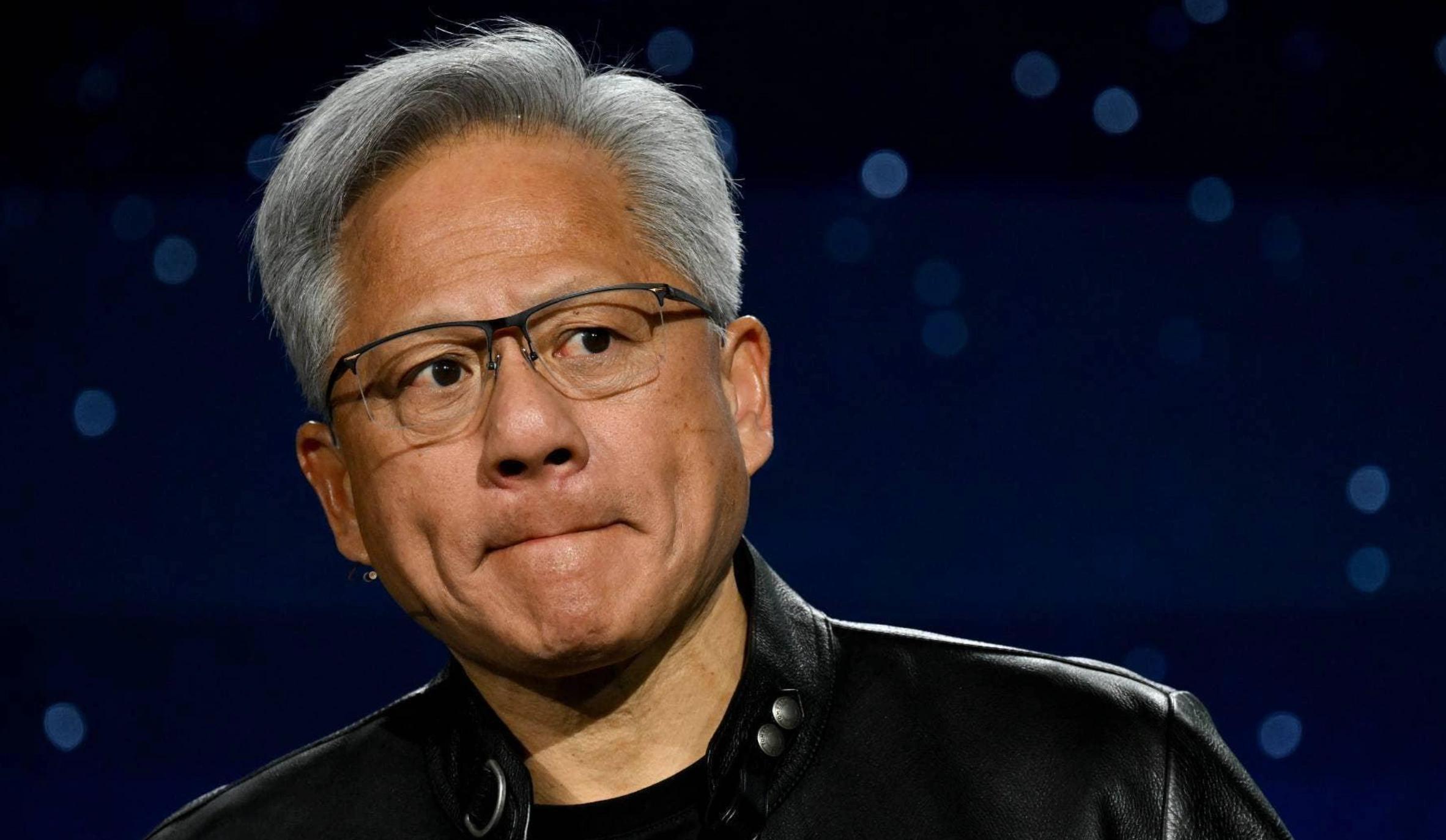
Nvidia's $200B Wipeout: Spy Scandal Meets DOJ Probe
Nvidia shares shed nearly 5.5% in a session as a Chinese espionage scandal and dual DOJ investigations converge ahead of Nov. 17 earnings. Here's what traders need to know.
Key Points
- Nvidia shares fell 5.47% to $168.89, erasing close to $200 billion in market cap over two sessions as a board-level espionage investigation targeting CEO Jensen Huang collided with an active DOJ criminal probe into chip smuggling.
- Megaspeed International, a Singapore-based firm believed to have purchased more than $4.8 billion in Nvidia chips since June 2024, is now the subject of a Justice Department criminal investigation into alleged smuggling of AI chips to China.
- With earnings six days out on November 17, traders need a clear view on whether the $168 handle holds — or whether a fresh headline breaks it before Nvidia ever gets to report.
Nvidia closed Tuesday at $168.89, down 5.47%, as two separate Department of Justice investigations — one criminal, one antitrust — fused with a board-level probe into CEO Jensen Huang's personal relationship with an alleged Chinese intelligence operative. The combined headline weight erased close to $200 billion in market capitalization over two sessions, and the earnings date of November 17 is now six days away with more legal exposure potentially arriving before the company even opens its books.
The Scandal at the Center
The core story is Megaspeed International, a Singapore-based firm that US intelligence believes has been funneling Nvidia chips into China in violation of export controls. According to Bloomberg's reporting, Nvidia's own general counsel intervened in the US government's probe of Megaspeed — an intervention that prompted the Commerce Department to pause its own work on the case and hand the criminal matter to the Justice Department. That sequence of events — a chipmaker's lawyer inserting itself into a federal investigation — is itself the kind of disclosure that rattles institutional holders regardless of its ultimate legal significance.
The numbers behind Megaspeed are what make this more than a footnote. The firm, originally spun out of a Chinese parent company, reportedly purchased more than $4.8 billion worth of Nvidia chips since June 2024 alone. That is not a rounding error or a gray-market side channel — that is a volume figure that would put Megaspeed among Nvidia's larger distribution partners by revenue. The Justice Department is now running a criminal investigation into whether those chips reached sanctioned Chinese end-users, and Megaspeed executive Alice Huang — no relation to Jensen — is believed by US intelligence to be an active Chinese intelligence operative.
The Jensen Huang dimension is where the story becomes structurally dangerous for the stock. A board investigation into the CEO's personal relationship with a suspected Chinese spy is the kind of disclosure that can pressure a governance-sensitive institutional base. Large passive holders, pension funds, and sovereign wealth vehicles that hold NVDA for index purposes face reputational and compliance questions of their own if the investigation deepens. The board probe has no stated timeline, which means it becomes a persistent overhang rather than a discrete event traders can price and move past.
Dual Legal Exposure, No Clear Exit
What makes the legal picture unusually complex is that the espionage-linked criminal probe is running simultaneously with a separate DOJ antitrust investigation — and the two are legally distinct enough that resolving one does nothing to close the other. The antitrust division has issued subpoenas not only to Nvidia but to third-party companies in its orbit, suggesting investigators are building a structural case around market access and competitor foreclosure rather than simply gathering preliminary facts. That is a later-stage investigative posture.
Layered on top: records show that China's Northwestern Polytechnical University — an institution with documented ties to the People's Liberation Army and long present on the US export blacklist — accessed two Nvidia H200 chips through a Chinese reseller for $123,000. That transaction is a case study in exactly what the proposed Chip Security Act, now being pushed by Democratic Rep. Bill Foster and Republican Rep. Bill Huizenga, is designed to prevent. Foster cited Jensen Huang's relationship with Alice Huang explicitly in his call to advance the legislation, ensuring the espionage narrative is now entangled with active legislative debate, not just executive-branch enforcement.
The policy feedback loop matters for traders because it complicates the standard "wait for the legal process to play out" holding thesis. When legislators start citing a CEO's personal conduct in public calls for new law, the probability distribution of outcomes widens. The Chip Security Act, if it moves, would impose location-tracking requirements on chips sent overseas — a compliance infrastructure burden that lands directly on Nvidia's sales model in markets where verification is currently opaque.
Nvidia's own infrastructure commitment exposure adds another layer. The company has $900.9 billion in computing and infrastructure commitments on its books, a figure that dwarfs the $26 billion in strategic investor capital being raised by Anthropic for its IPO — and a figure that becomes a leverage concern if enterprise customers pause purchasing decisions pending legal clarity. Even a 60-day procurement freeze among major hyperscaler buyers would show up in guidance language on November 17.
What Traders Watch Next
The immediate technical question is whether $168 holds into earnings. The stock closed at that handle Tuesday after a two-session, $200 billion drawdown, and premarket today shows some recovery alongside Micron and SK Hynix — suggesting the initial panic selling has partially exhausted itself. But a stabilization in premarket is not the same as a resolved thesis. The criminal probe has no stated end date, the board investigation has no stated end date, and antitrust subpoenas to third parties suggest the DOJ is still in a document-gathering phase, not a resolution phase.
AMD is the clearest near-term beneficiary of the distraction — the stock gained 1.30% Tuesday while NVDA fell 5.47%, and AMD has now outperformed NVDA by approximately 25% over two sessions. Alphabet's decision to select AMD's EPYC processors for its TPU 8tx systems, announced today alongside AMD's 6th Gen EPYC 9006 Venice launch, is the kind of hyperscaler reference win that reinforces the rotation thesis. For traders holding NVDA into November 17, the calculus is now a function not just of data center demand — which remains strong by every measure including TSMC's "insatiable" characterization from the Nikkei Forum today — but of whether a new legal headline drops in the six days between now and the earnings call. The $168 level is the line; a close below it before earnings would signal that institutional de-risking has resumed and the panic-selling phase is not, in fact, over.
The Weekly Investor
Daily market analysis for active traders. Free.