NVDA -3% After Historic 31% Surge: What's Next
Nvidia gives back 3% Tuesday after Monday's historic 31.5% single-session surge. Here's what traders need to watch as the dust settles on Jensen Huang's return.
Key Points
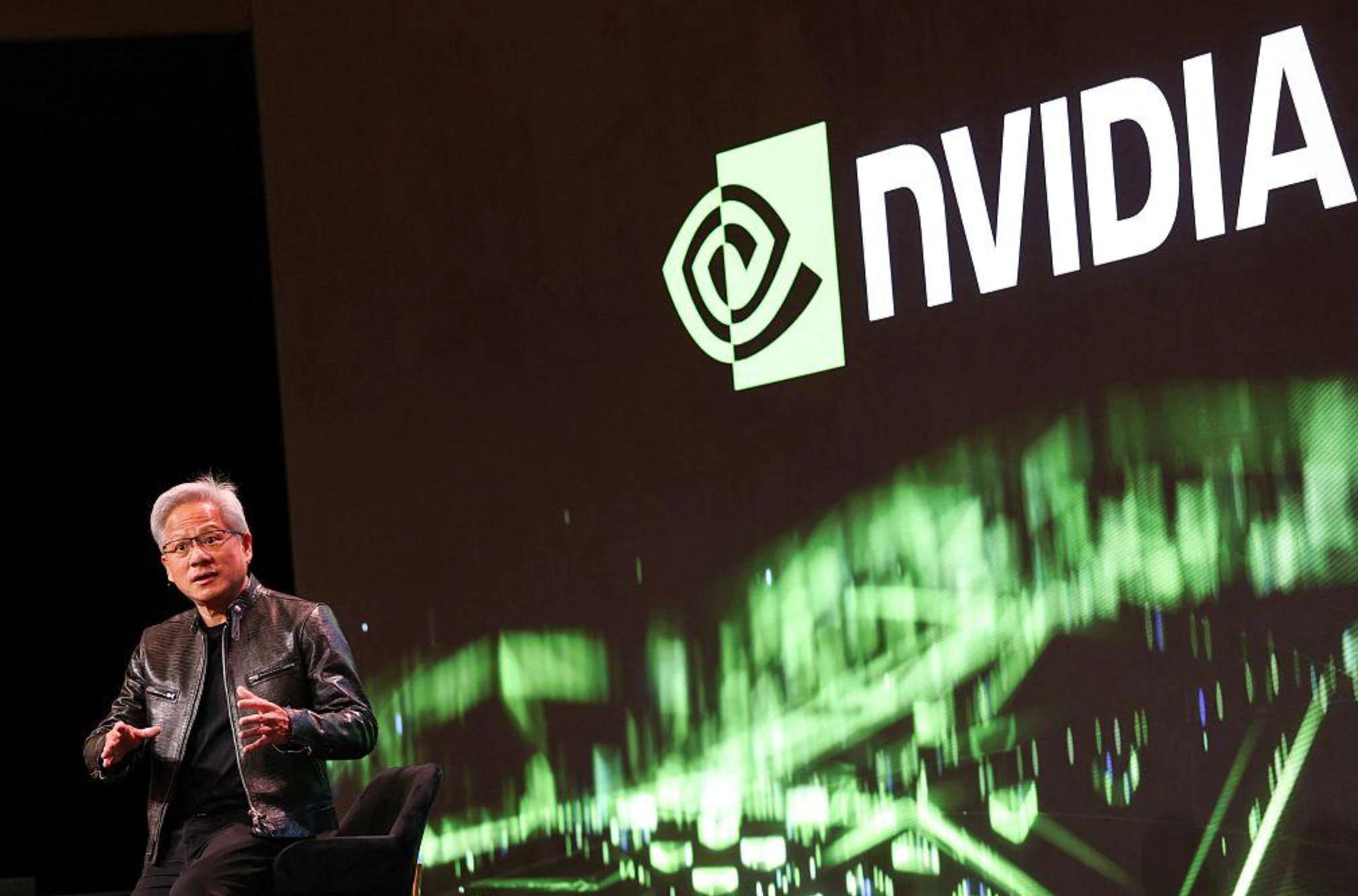
- Nvidia surged 31.5% Monday to $165.05 on 776 million shares traded — its biggest single-session percentage gain in 23 years — after the board unanimously reinstated Jensen Huang as CEO effective immediately.
- The catalyst is explicitly political: President Trump spoke directly with Nvidia's board, providing input that cleared Huang's return on national security grounds after his November 13 resignation over an extramarital affair with an alleged Chinese spy.
- Watch the $160 level as near-term support Tuesday; DELL's AI server print after the close tonight — with a $95 billion backlog — will determine whether the AI infrastructure trade holds its footing or unravels further.
Nvidia shed approximately 3% in Tuesday trading, pulling back to roughly $160 after Monday's $165.05 close — the natural exhale after a session that added nearly $1 trillion in market value in a single day on 776 million shares, the most consequential print in the semiconductor sector in at least two decades.
The Trade That Broke the Tape
Monday's 31.5% surge is not a number that fits neatly into normal market analysis frameworks. To put it in context: Nvidia added more market capitalization in one session than the entire market cap of most S&P 500 members. The volume — 776 million shares — eclipses typical daily turnover by a factor of roughly five to seven, suggesting this was not just momentum traders piling in. Institutions that had been forced to reduce exposure following the November 13 resignation were buying back aggressively, covering positions built over years of AI-cycle accumulation.
The trigger was blunt and unusual. Nvidia's board announced that Jensen Huang had been reinstated as President and CEO, effective immediately, following a unanimous board vote after what the company described as "a series of discussions and meetings" with Huang. The board disclosed it had received input from "senior levels of the United States government," and that President Trump had spoken directly with board members. The board stated it was confident Huang's return posed no national security risk. That language — presidential contact, national security clearance — is without modern precedent in a corporate leadership announcement from a publicly traded U.S. company.
The read-across was violent and broad. Chipmakers jumped 18% as a group Monday. SK Hynix and Dell both soared 22%. Micron rose 19%. TSMC and Foxconn each climbed nearly 10%. Astera Labs gained 23.2%, Credo Technology 22.6%, CoreWeave 22.3%. Tesla — tethered to the AI and compute infrastructure narrative through its Dojo supercomputer ambitions — gained 11.5%. The Nasdaq Composite closed up 6.51%, the S&P 500 gained 4.73%, and the Dow added 3.01%. This was not a sector rotation. This was a full-market repricing of AI infrastructure risk in a single afternoon.
The Political Overhang That Won't Go Away
The circumstances surrounding Huang's original November 13 resignation remain complicated, and the Tuesday pullback reflects the market processing residual uncertainty rather than fundamental doubt about Nvidia's business trajectory. Huang resigned after reports surfaced that he had engaged in several extramarital affairs, including one with a woman described as an alleged Chinese spy. Huang disclosed one affair in a note to employees. The original resignation sent NVDA down sharply and triggered a broad recalibration of AI hardware names that had been priced for perfection.
The reinstatement does not erase that background. It reframes it through a presidential imprimatur. Whether that framing holds politically — in a Washington environment where China-linked security concerns are combustible — is a risk that cannot be priced away with a single board vote. Investors who bought Monday's close at $165.05 are now sitting on a 3% loss Tuesday, which is entirely rational given the event risk still embedded in the name. Any re-emergence of national security questions, whether from Congress, intelligence agencies, or media reporting, could immediately pressure the stock below Monday's pre-surge levels.
What the market is effectively betting is that the presidential seal of approval is durable. That is a political judgment, not a financial one, and it deserves to be treated as a distinct risk factor in any position sizing calculation.
What Traders Watch Next
The immediate technical level is $160. That is where Tuesday's pullback appears to be stabilizing as of midday, and it represents roughly a 50% retracement of Monday's intraday range from the open to the $165.05 close. A failure to hold $160 on a closing basis Tuesday would signal that the institutional buy-the-reinstatement trade is unwinding faster than expected, and would put the $148-$150 zone — Nvidia's approximate pre-bounce level — back in play.
The more important catalyst arrives tonight. Dell Technologies reports after the close with consensus EPS of $6.62 on revenue of $49.32 billion, a figure that would represent an 83% year-over-year revenue increase driven almost entirely by AI server demand. Dell's last quarter produced $16.4 billion in AI server revenue and left the company sitting on a record $95 billion backlog. Full-year AI server revenue guidance now stands at $74 billion. If Dell delivers on that number and raises forward guidance, it confirms that the AI infrastructure buildout Nvidia enables is a real, durable, order-driven cycle — not speculative froth. That print matters more for the medium-term NVDA setup than anything that happened in Monday's session.
Hewlett Packard Enterprise's Monday move offers additional context. HPE gained 17.38% to $48.02 on its own Q4 beat, though the company was notably cautious about financing what it called "neocloud or high-risk customers." That qualifier is worth filing. It suggests not all AI infrastructure demand is treated equally by the hardware suppliers closest to the buildout. If Dell tonight echoes any similar customer-quality caution, the market will read it as a ceiling on the AI server cycle's upside, which would put renewed pressure on NVDA even with Huang back in the chair. The key number to watch: Dell's backlog figure. If it comes in above $95 billion, the AI trade stays alive. If it shrinks, the Tuesday pullback in NVDA could have further to run before the week is out.
The Weekly Investor
Daily market analysis for active traders. Free.