Tech and Semis Get Crushed Monday as Defensives Take Over
SOXX crashed 5.41% and XLK fell 3.24% on Monday as institutions rotated hard into XLV, XLP, and XLU. Here's what the sector tape is signaling.
Key Points
- SOXX closed 5.41% lower at $141.22 on Monday and is down 14.13% over the last month, while XLK shed 3.24% to $164.76 — the sharpest single-day divergence from defensive sectors in months.
- Institutional money is rotating into Health Care (XLV +0.54%), Consumer Staples (XLP +0.49%), and Utilities (XLU +0.39%) in a textbook risk-off move amplified by crude oil's 2.62% drop.
- Watch whether XLK tests the $160 level and whether SOXX's overnight recovery of 0.81% can build into a sustained bid or fades into the 14% monthly downtrend.
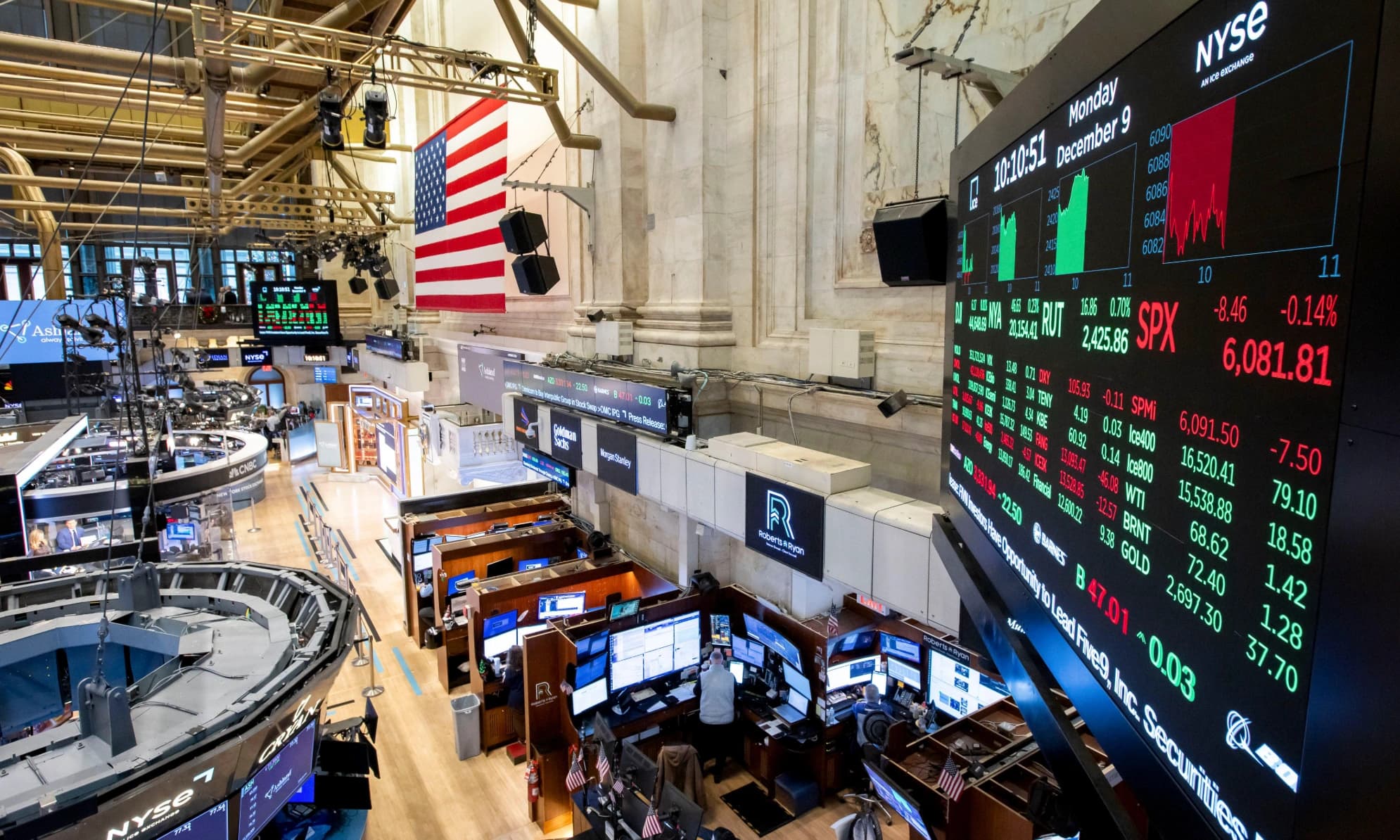
Monday's equity session delivered one of the clearest institutional de-risking signals of the fourth quarter: SOXX cratered 5.41% to close at $141.22 while XLK dropped 3.24% to $164.76, and ten of eleven S&P 500 sectors outperformed the benchmark index itself. The money didn't disappear — it rotated hard into Health Care, Consumer Staples, and Utilities, the classic defensive trio that institutions reach for when they're reducing risk exposure rather than simply taking profits.
The Defensive Bid and What It Means
The outperformers on Monday were not random. Health Care ETF XLV led all sectors with a gain of 0.54%, powered by UnitedHealth climbing 1.37%, AbbVie adding 1.08%, and Eli Lilly rising 0.96%. Consumer Staples ETF XLP posted 0.49%, with Procter & Gamble up 1.63%, PepsiCo gaining 1.26%, and Coca-Cola adding 0.77%. Utilities ETF XLU tacked on 0.39%, with Duke Energy up 1.35%, Southern Company gaining 0.82%, and NextEra adding 0.79%. These are not momentum plays — they are capital preservation vehicles, and their simultaneous strength on a down day for the broader market is a signal about institutional intent, not sector-specific catalysts.
What makes Monday's defensive rotation particularly notable is the breadth of participation. Real Estate (XLRE) added 0.09%, landing in modestly positive territory. Even the midpack laggards — Materials (XLB) at -0.57%, Consumer Discretionary (XLY) at -0.84%, Industrials (XLI) at -0.87% — were losing ground at a measured pace compared to the outright destruction in technology and semiconductors. When institutions de-risk, they typically sell their most liquid, highest-beta positions first and park the proceeds in defensives. Monday's tape matched that playbook almost exactly, with the spread between XLV's gain and SOXX's loss exceeding six percentage points in a single session.
The XLK and SOXX Damage in Detail
The scale of the technology and semiconductor selloff deserves to be examined carefully because it goes well beyond one bad session. XLK, which holds $118.7 billion in assets and carries a PE ratio of 29.06, closed at $164.76 — down $5.52 on the day. Its year-to-date daily total return stands at 18.69%, which means Monday's decline took a meaningful bite out of a year that had been strong for tech. At $164.76, XLK is approaching a level where the 2026 gains start to look significantly more modest, and a push toward $160 would constitute a 15% drawdown from recent highs — the technical threshold that often triggers forced selling from risk-parity and volatility-targeting funds.
SOXX tells a more alarming story. The semiconductor ETF closed at $141.22 — down 5.41% in a single session — and is now 14.13% lower over the trailing month. Year-to-date, SOXX remains up 38.94%, which means the full-year gain is still intact, but that monthly drawdown figure signals serious technical damage. A 14% one-month decline is not noise; it's a trend. The overnight recovery of 0.81% in Tuesday's session is worth monitoring but should not be over-interpreted — one overnight session of modest green does not reverse the kind of systematic institutional selling that produces a 14% monthly loss. The overnight bid could reflect short covering or Asia-based flows rather than a genuine shift in the dominant institutional posture.
Energy Adds a Macro Wrinkle — and Watch the $160 Level
XLE added a macro dimension to Monday's selloff that isn't immediately obvious from the sector rankings alone. The energy ETF fell 1.28%, with ExxonMobil down 1.59%, SLB off 1.55%, and ConocoPhillips losing 1.27% — but the driver here was crude oil futures, not equity-specific selling. WTI crude December '26 futures dropped $2.32, or 2.62%, to $86.24 on the day. That's a macro signal about demand expectations, not a sector rotation trade. XLE carries $46.4 billion in assets, yields 2.18%, and has a 52-week range of $43.77 to $70.15 — at $63.99 Monday, it's trading in the lower half of that range, and a crude oil price that continues to soften will test whether the $43.77 floor from earlier in the range remains a distant memory or a live risk.
The convergence of weak crude, tech destruction, and defensive rotation into a single session is the kind of macro-meets-sector signal that traders should take seriously. Each element reinforces the others: falling oil implies slowing demand implies a slower economy implies reduced corporate earnings implies a multiple compression risk for high-PE technology stocks. XLK's PE of 29.06 is not extreme by recent standards, but it's not cheap either, and in a rising-risk-off environment, compression from 29x toward 25x would take XLK from $164.76 to somewhere around $141 — a level that would represent a full round-trip to SOXX's current price and a wipeout of most of XLK's 2026 gains. The specific level to watch for XLK is $160. A clean break below that figure, particularly on volume, would likely accelerate the institutional de-risking already visible in Monday's tape and could trigger the kind of mechanistic selling from quantitative funds that turns a rotation into a rout. Tuesday's open will be the first test of whether Monday was an event or the beginning of a regime.
The Weekly Investor
Daily market analysis for active traders. Free.