NVDA Board to Oust Jensen Huang: Stock -15% in November
Nvidia's board is weighing Jensen Huang's removal after spy affair bombshell. NVDA down 8.62% after hours, $700B in market cap erased in days.
Key Points
- Nvidia shares fell 8.62% in after-hours trading Wednesday to $158.76, erasing approximately $700 billion in market cap over the past week.
- The board has retained Wachtell, Lipton, Rosen & Katz to investigate national security allegations linking Huang to a suspected Chinese intelligence operative, while simultaneously searching for a replacement CEO.
- Traders have five days until Nvidia's November 17 earnings print — the board's decision, expected imminently, will determine whether that event is a governance crisis or a business story.
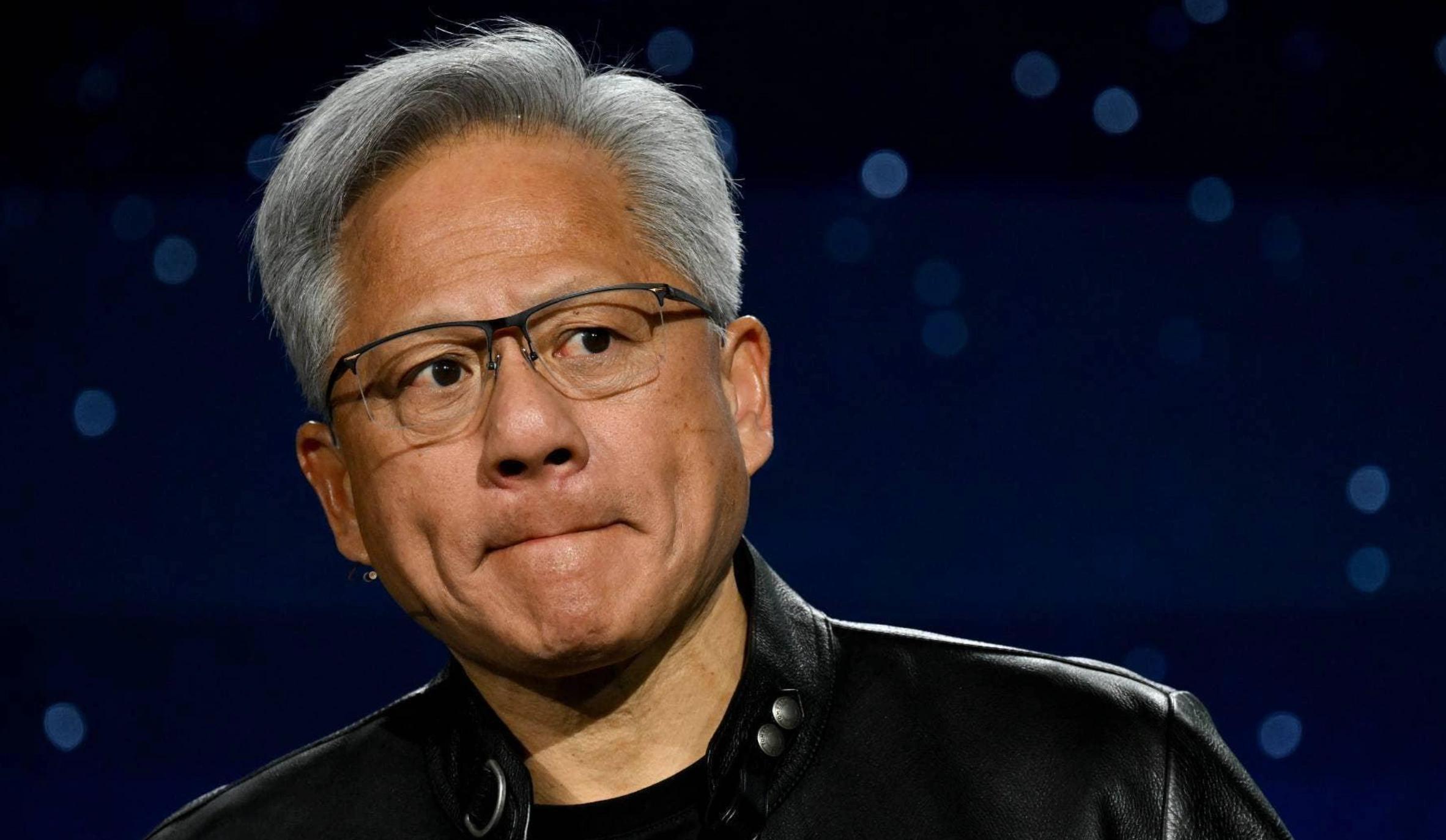
Nvidia's board met late Wednesday to decide whether to remove Jensen Huang as CEO, and the market's verdict on the outcome landed before any official announcement: shares fell 8.62% in after-hours trading to $158.76 after closing the regular session at $173.73. The stock is now down approximately 14% in November alone, and the company has shed roughly $700 billion in market capitalization in a matter of days — the fastest destruction of value in Nvidia's history.
The Charges Against Huang
The cascade began when the Wall Street Journal reported that Nvidia's board was preparing to force out its co-founder and CEO following the emergence of two separate extramarital affairs. The first involves a businesswoman whom U.S. intelligence has identified as a suspected operative linked to Chinese intelligence services. The national security dimension of that relationship is not theoretical: Nvidia manufactures the most strategically important semiconductors on the planet, and the company is already under a Department of Justice antitrust investigation that has expanded to include subpoenas of third-party companies. The combination of a compromised CEO and an active federal probe is a governance disaster by any measure.
The second affair is a more conventional corporate scandal with serious legal implications of its own. Huang allegedly maintained a relationship with Kimberly Powell, Nvidia's Vice President of Healthcare, who reports directly to him. That direct reporting line transforms a personal matter into a textbook HR liability — one that creates exposure under securities law if the board can be shown to have known and failed to act. Nvidia's bylaws permit removal of the CEO with or without cause by a majority board vote, so the procedural path to Huang's exit is clear. What remains unclear is the timeline and whether Huang will contest any action.
Congressional pressure is now compounding the board's urgency. Lawmakers have threatened to subpoena Huang over the relationship with the alleged Chinese national, and the national security-tech nexus that has driven chip export controls for the past three years is now centered on Nvidia's executive suite. That political dimension makes it harder for the board to adopt a wait-and-see posture — every day of inaction is a day that Congress can characterize as complicity. Wachtell, Lipton, Rosen & Katz, the law firm retained to conduct the independent investigation, is best known for high-stakes M&A defense and corporate control contests. Their involvement signals the board is treating this as a maximum-severity event.
What the Market Is Actually Pricing
Wednesday's regular session offered a brief, misleading reprieve. Nvidia shares bounced alongside the broader semiconductor complex after CoreWeave raised its full-year revenue outlook to $13.0–$13.3 billion, up from a prior range of $12–$13 billion, and reported roughly $9 billion in expected customer prepayments and deposits over the next three months. CRWV surged 23.60% on that news, and the AI infrastructure trade roared back to life — AMD gained 8.84%, Broadcom rose more than 5%, TSM jumped 4%, and ASML added 3%. For approximately six hours, it looked like the sector had stabilized.
Then the after-hours report dropped. CNBC confirmed the board meeting and the scope of the allegations, and NVDA gave back all of Wednesday's gains and then some. Pre-market data for Thursday morning shows the damage spreading: NVDA is indicated down another 6.9%, with MRVL off 3.7%, KLAC down 3.7%, ARM lower by 3.3%, MU falling 3.2%, and AMAT declining 2.9%. The correlation tells the story — this is no longer being priced as a single-stock idiosyncratic event. The market is reassigning a governance risk premium to the entire AI semiconductor supply chain.
Baird downgraded NVDA to Neutral on Thursday morning, joining a growing list of analysts who cannot construct a price target around a company whose leadership structure is unresolved. The irony is brutal: Nvidia's business has never been stronger. The CoreWeave blowout is direct evidence of that — CoreWeave runs on Nvidia H100 and GB200 clusters, and its raised guidance is effectively a demand attestation for Nvidia's products. The fundamentals and the governance situation are pointing in exactly opposite directions, which is precisely what makes this stock so dangerous to hold through the weekend.
What Traders Watch Next
The TSMC angle deserves more attention than it has received. TSMC manufactures Nvidia's most advanced chips under a relationship so deep and interdependent that any disruption to Nvidia's executive continuity creates real operational risk. TSMC's own stock is down 2.0% in pre-market trading Thursday, a modest decline that likely understates the exposure if Huang's departure triggers strategic uncertainty around Nvidia's next-generation product roadmap. AMD's pending $8.2 billion all-stock acquisition of World Labs, Fei-Fei Li's spatial intelligence company, remains listed as pending in AMD's November 4 Form 10-Q — a deal that looks increasingly well-timed as AMD positions itself to absorb any enterprise AI customers who want to diversify away from an Nvidia platform in leadership turmoil.
The five-day clock is the critical variable. Nvidia reports quarterly earnings on November 17, and the numbers, by all available evidence, will be strong. Applied Materials is reporting today and expected to post $10.25 billion in quarterly revenue with $4.02 in adjusted EPS, alongside $9.3 billion in AI infrastructure orders received during Fiscal 2026 — another data point confirming the capex cycle is intact. But a strong earnings print means nothing if Nvidia walks into that call without a clear answer to the first question every analyst will ask: who is running this company? The board's decision — expected within the next 72 hours — is the only number that matters between now and the open bell on November 17. Watch $158 as the immediate technical floor; a confirmed break below that level in Thursday's regular session opens a path toward $145, the last significant support zone before the summer consolidation range.
The Weekly Investor
Daily market analysis for active traders. Free.