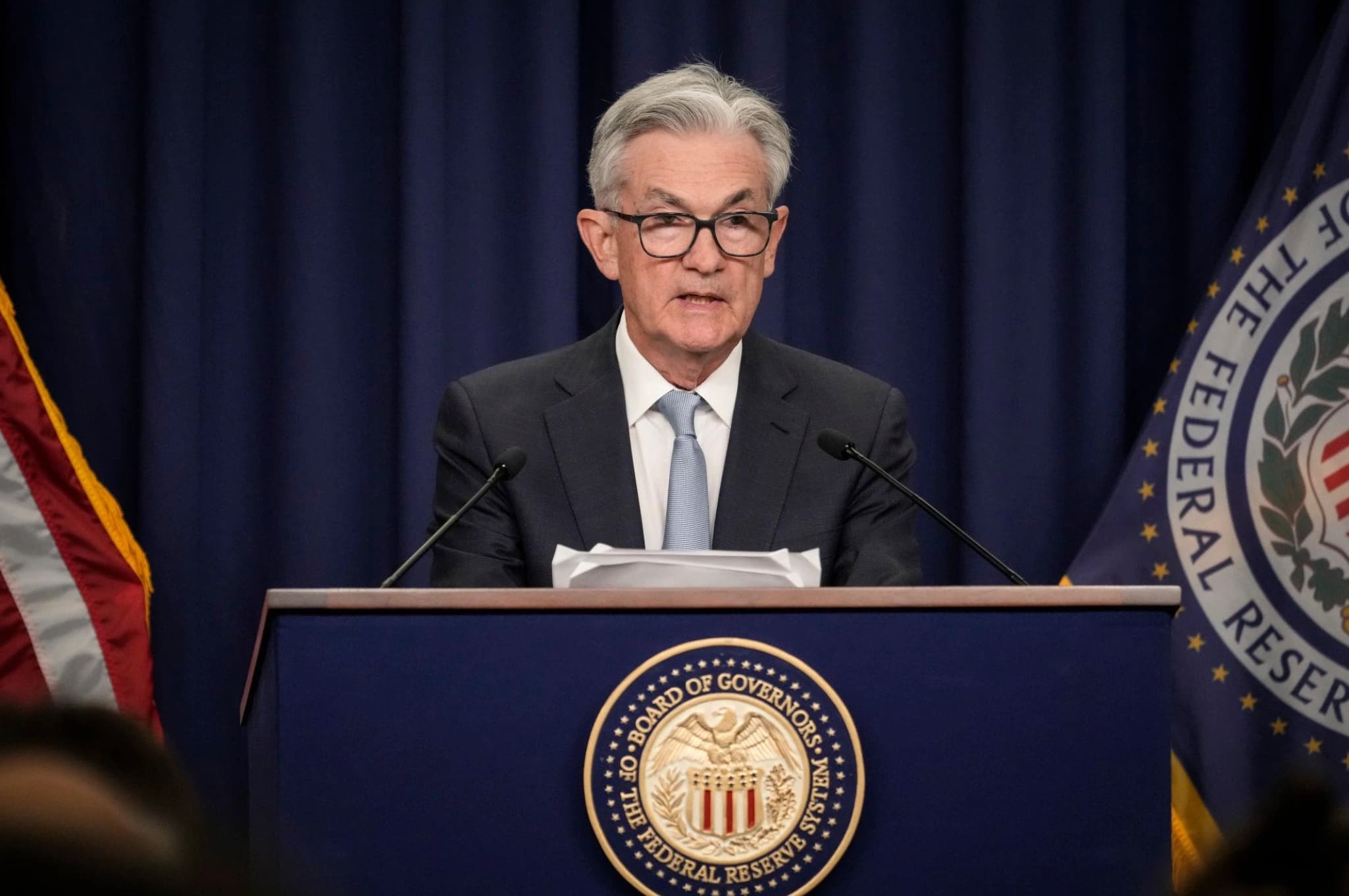
Fed's Waller Puts 50 BPS December Hike on the Table
Fed Governor Waller signals a 25 bps December hike as the base case but warns a 0.3%+ core CPI print could force 50 bps. Here's what traders need to know.
Key Points
- Fed Governor Christopher Waller explicitly named 0.3% MoM core CPI as the threshold that would put a 50 bps December hike on the table, against a base case of 25 bps.
- With October payrolls already printing at +165,000 and unemployment anchored at 4.1%, the Fed has no labor market cover to stay dovish if today's inflation data surprises hot.
- Traders should watch the December 8–9 FOMC meeting as the live catalyst, with today's CPI release functioning as the last significant data point to shift the committee's hand before that decision.
Fed Governor Christopher Waller drew the clearest line yet this morning: 25 basis points in December is his base case, but a core CPI print of 0.3% or higher today changes the math. Speaking at the Bank of England Watchers Conference in London, Waller said he would support a quarter-point hike even if inflation improves from September's elevated reading — but added, "if inflation comes in substantially higher than I expect, more robust action by the FOMC may be called for." That is the most explicit hawkish conditionality any Fed official has attached to December's outcome, and it landed on the same morning traders were already bracing for the most consequential data release of the month.
Waller Sets the Line
The significance of Waller's London remarks is not just what he said — it's the threshold he implicitly defined. September's core CPI came in at 0.3% month-over-month, which the Fed's hawks viewed as troubling but not quite disqualifying for a measured pace of tightening. If October delivers the same or worse, Waller's language today suggests 50 bps becomes an active conversation inside the FOMC, not merely a tail risk floated by analysts. The Cleveland Fed's nowcast pegs October core at 0.21% MoM, and the Bloomberg survey median sits near 0.3% — meaning the actual print landing anywhere near the top of that range would be precisely the trigger Waller named.
What makes this more than routine Fed speak is Waller's standing within the committee. He is a Fed Board Governor, not a regional bank president, which means he is a permanent FOMC voter and his remarks carry direct policy weight. His assessment that the labor market is "solid" — despite unemployment sitting at 4.1% — signals he is not prepared to let a cooling jobs picture serve as an excuse to slow the tightening pace. That view is now explicitly on the record ahead of the blackout period that precedes the December 8–9 meeting. Bloomberg's coverage of Waller's London remarks confirms the governor also addressed growth, noting he expects Q4 GDP to moderate as consumer spending normalizes — but critically, he did not treat that as a reason to pause.
What the Data Actually Shows
The inflation backdrop entering today's print is uncomfortable in every direction. September's headline CPI surged 0.6% MoM — the largest monthly gain since April — with gasoline and shelter as the primary culprits. Core PCE, the Fed's actual target gauge, ran at 3.1% year-over-year in September against a 2% objective. That gap is not closing fast enough to give the committee confidence that one more meeting at a moderate pace will suffice. The October report was always going to be scrutinized — but Waller's remarks this morning transformed it from an important data point into a binary trigger.
There are legitimate reasons to expect moderation. Retail gasoline prices fell 0.9% from September to October before seasonal adjustment, per EIA data, which should drag headline lower and ease some of the feed-through into transportation-related services. Airfares, which have been a persistent source of core services volatility, are also expected to decelerate or decline. But shelter inflation — which carries roughly one-third of the CPI basket — is not expected to show meaningful relief. Owners' equivalent rent has been stubborn throughout 2026, and there is no structural reason for it to break sharply lower in a single month. The Cleveland Fed's 0.21% nowcast for core represents the optimistic scenario; the Bloomberg survey's 0.3% median represents the scenario that puts Waller's conditional 50 bps back on the table. The range between those two numbers is the entire trade.
One complicating factor that deserves attention: the BLS will not publish year-over-year figures for October because comparison data from October 2025 is unavailable — the government shutdown that month meant prices were never collected. That structural data gap eliminates one of the standard framing anchors traders typically use to contextualize the monthly print, forcing more weight onto the raw MoM figure and the Fed's reaction to it.
What Traders Watch Next
The December FOMC meeting on December 8–9 is now the event horizon, and today's CPI release is the last major inflation data point that will reach committee members before the blackout period closes. That alone explains why rate hike odds have already shifted to approximately 80% for December following last week's strong payroll report — and why Waller's willingness to name a larger increment publicly is so significant. There are no subsequent CPI prints, no additional PCE readings, no major labor market surprises left in the calendar window. What the Fed sees today is essentially what it goes into December with.
Also speaking today are Philadelphia Fed President Anna Paulson at 6:30 PM ET, Kansas City Fed President Jeff Schmid at 1:30 PM ET, and Boston Fed President Susan Collins at 9:10 AM — a wall of Fed communication that will be parsed for any pushback against or endorsement of Waller's framing. If Paulson, an FOMC voter, echoes the conditional 50 bps language, the market's December pricing will move materially. If she or Schmid signal comfort with 25 regardless of today's print, that provides some offset. The 10-year Treasury yield is the instrument to watch in real time — a core CPI print at or above 0.3% MoM should push the 10-year toward and potentially through 4.75%, while a sub-0.2% surprise to the downside could pull it back below 4.50%. The Atlanta Fed's GDPNow tracker has Q4 growth at 3.4%, meaning the Fed cannot hide behind a weakening economy. The only question left for December is 25 or 50 — and today's number at 8:30 AM ET decided it.
The Weekly Investor
Daily market analysis for active traders. Free.