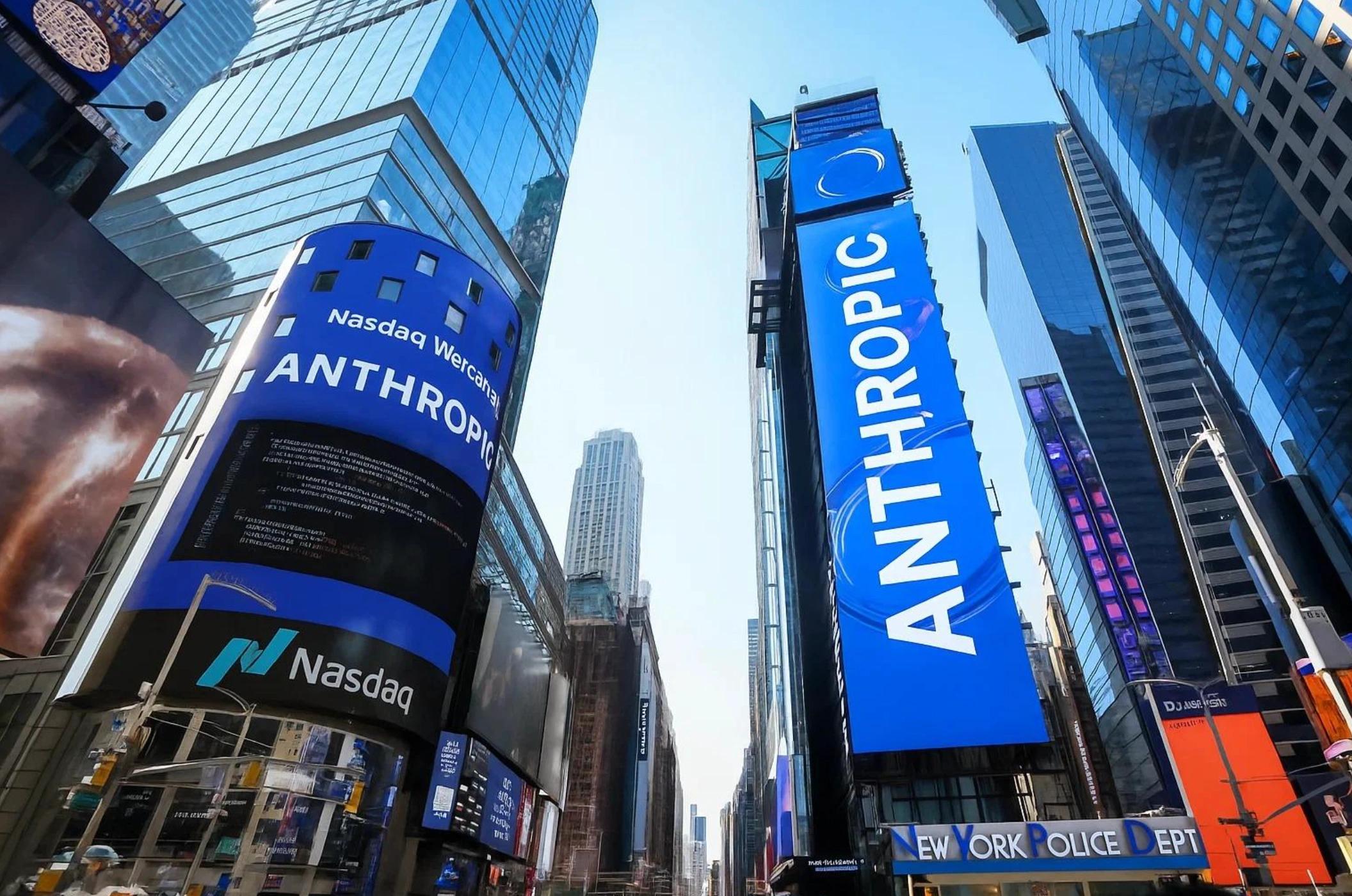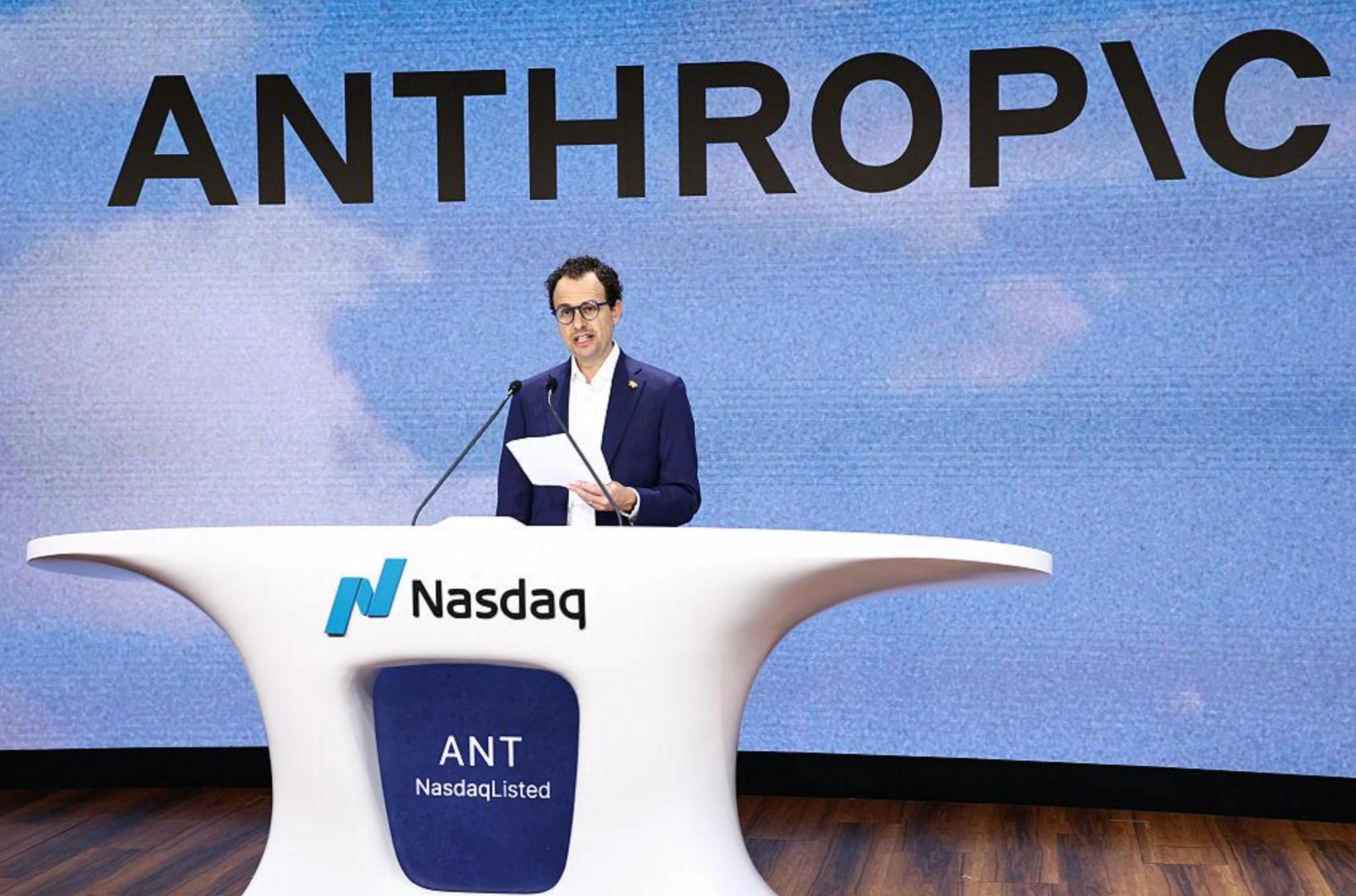
Anthropic IPO Prices Wednesday: What to Watch
Anthropic prices its IPO Wednesday after reporting a $104B net loss. It's the first pure-play generative AI public offering — and institutional demand tells all.
Key Points
- Anthropic reported a net loss exceeding $104 billion in the nine months through September 2026, the vast majority of which reflects non-cash accounting adjustments to financing instruments rather than operating cash burn.
- The IPO lands the day after Nvidia's Q3 print, making institutional risk appetite for frontier AI directly readable from two simultaneous price signals on Tuesday night and Wednesday.
- Traders should watch Anthropic's final pricing versus its indicated range as the clearest real-time gauge of how deep-pocketed buyers value pure generative AI exposure at scale.
Anthropic prices its IPO Wednesday, landing one day after Nvidia's Q3 earnings — making this the most concentrated 48-hour window of AI-sector price discovery since the bull market began. The company carried a net loss exceeding $104 billion in the nine months through September 2026, a figure that will dominate headlines but obscures the operating reality: the bulk of that loss reflects non-cash accounting adjustments to financing instruments, not cash incineration from running Claude.
The Loss Number That Isn't What It Looks Like
Anthropic's $104 billion net loss over nine months will be the first number every retail investor sees, and it will be almost entirely misleading without context. The company, like many late-stage AI ventures, has raised capital through financing structures — convertible instruments, preferred equity tranches with embedded features — whose fair-value accounting treatment generates enormous non-cash losses on the income statement as the company's own valuation rises. The more successful Anthropic becomes, the larger those non-cash losses appear. It is the peculiar accounting logic of high-growth, heavily-funded private companies hitting the public market: the headline loss is a function of success, not failure.
What matters operationally is the trajectory of Claude's revenue, the cost-per-token economics as Anthropic scales its model infrastructure, and the gross margin profile of its enterprise contracts versus API consumption. None of those figures have been fully disclosed in pre-IPO materials available to the public, which is precisely why the institutional book-build — and the final price relative to the indicated range — is the most important single data point this week that isn't Nvidia's guidance. TSMC has already signaled conviction, earmarking up to $1 billion to buy shares in both Anthropic and OpenAI. When the company manufacturing every frontier AI chip is writing equity checks into the model companies, it is not making a speculative bet; it is hedging its own customer concentration risk.
Claude vs. ChatGPT: The Commercial Stakes
The IPO arrives as the competitive landscape between Anthropic and OpenAI intensifies on the product side. OpenAI this week launched ChatGPT Wallet — a payment layer enabling AI agents to transact autonomously — alongside a new enterprise business layer letting companies manage their appearance inside the model and convert that visibility into direct commercial action. OpenAI simultaneously reported reaching $10 billion in quarterly revenue, even as heavy losses persist. That revenue figure, annualized to $40 billion, represents a commercial scale that Anthropic's IPO investors are implicitly betting Claude can challenge or carve a profitable niche beside.
Anthropic's counter-move is structural rather than consumer-facing. The company opened a private beta of self-hosted Claude Managed Agents this week — a product that runs entirely within a customer's own cloud or data center. The target market is regulated industries: financial services, healthcare, defense contractors, and government agencies that cannot send sensitive data to third-party inference endpoints. This is a market OpenAI's cloud-native architecture is poorly positioned to serve without significant re-engineering. It is also a market where pricing power tends to be durable, because switching costs are measured in compliance budgets and procurement cycles rather than monthly subscriptions. The on-prem enterprise AI opportunity is real, and Anthropic is first to formalize it at scale.
One analyst framing has gained traction in institutional conversations ahead of the roadshow: Anthropic represents "the first chance to buy a pure-play generative AI company rather than picks and shovels." The logic is straightforward. Every AI trade available to public market investors before this IPO has been indirect — Nvidia for compute, Microsoft for distribution, Google for search integration, Amazon for cloud infrastructure. Anthropic is the model itself. The bull case is that as token prices compress and consumption volume scales exponentially, the companies owning the most capable frontier models capture the largest share of AI-driven economic value. The bear case is that the model layer commoditizes faster than the revenue base can justify a public-market multiple, leaving investors with a structurally loss-making business in a price war against OpenAI, Google DeepMind, Meta's Llama, and a half-dozen well-funded challengers.
Reading Wednesday's Print Against Tuesday's
The sequencing of this week's two catalysts is not accidental, but it creates a live dependency that traders need to model explicitly. If Nvidia's Tuesday print and guidance land clean — $109 billion or better in revenue, $125 billion Q4 outlook, and a credible Kress answer on China compliance — risk appetite for frontier AI expands going into Wednesday morning. Institutions that were on the fence about Anthropic's book will lean in. If Nvidia stumbles, the reverse is true: a risk-off shock to the AI bull thesis the night before Anthropic prices is the worst possible setup for a company asking investors to pay a premium multiple on a business that has never turned a GAAP profit.
The broader context amplifies the stakes. The FTC and DOJ launched synchronized enforcement actions in 2026 targeting enterprise AI compute bundling and anti-competitive ecosystem lock-in. OpenAI's partnerships with Microsoft remain under FTC and UK CMA review over concerns about pseudo-mergers that sidestep normal merger review. Anthropic going public as a standalone entity theoretically sidesteps some of that regulatory pressure — it has no equivalent partnership structure with a single hyperscaler — but it also means it must fund its compute costs at market rates without a captive cloud subsidy. That cost structure will be visible in the S-1 and will be the number sophisticated buyers focus on after the non-cash loss noise is stripped away.
The specific level to watch Wednesday is whether Anthropic prices at, above, or below the top of its indicated range. A pricing above range signals institutional oversubscription and genuine conviction — the kind of book that supports a first-day pop and sets a durable floor for the aftermarket. A pricing at the midpoint or below signals that the Nvidia turbulence, the OpenAI revenue comparison, and the still-unresolved question of AI model commoditization are weighing on demand. That read will be more informative about the institutional view of frontier AI valuations than any analyst note published this quarter. Watch the opening print Thursday morning as confirmation — first-day trading on a high-profile AI IPO after a volatile Nvidia call will be one of the cleanest sentiment signals the market has produced in this cycle.
The Weekly Investor
Daily market analysis for active traders. Free.