VIX Near 20, 10-Year Above 5%: Monday's Risk Map
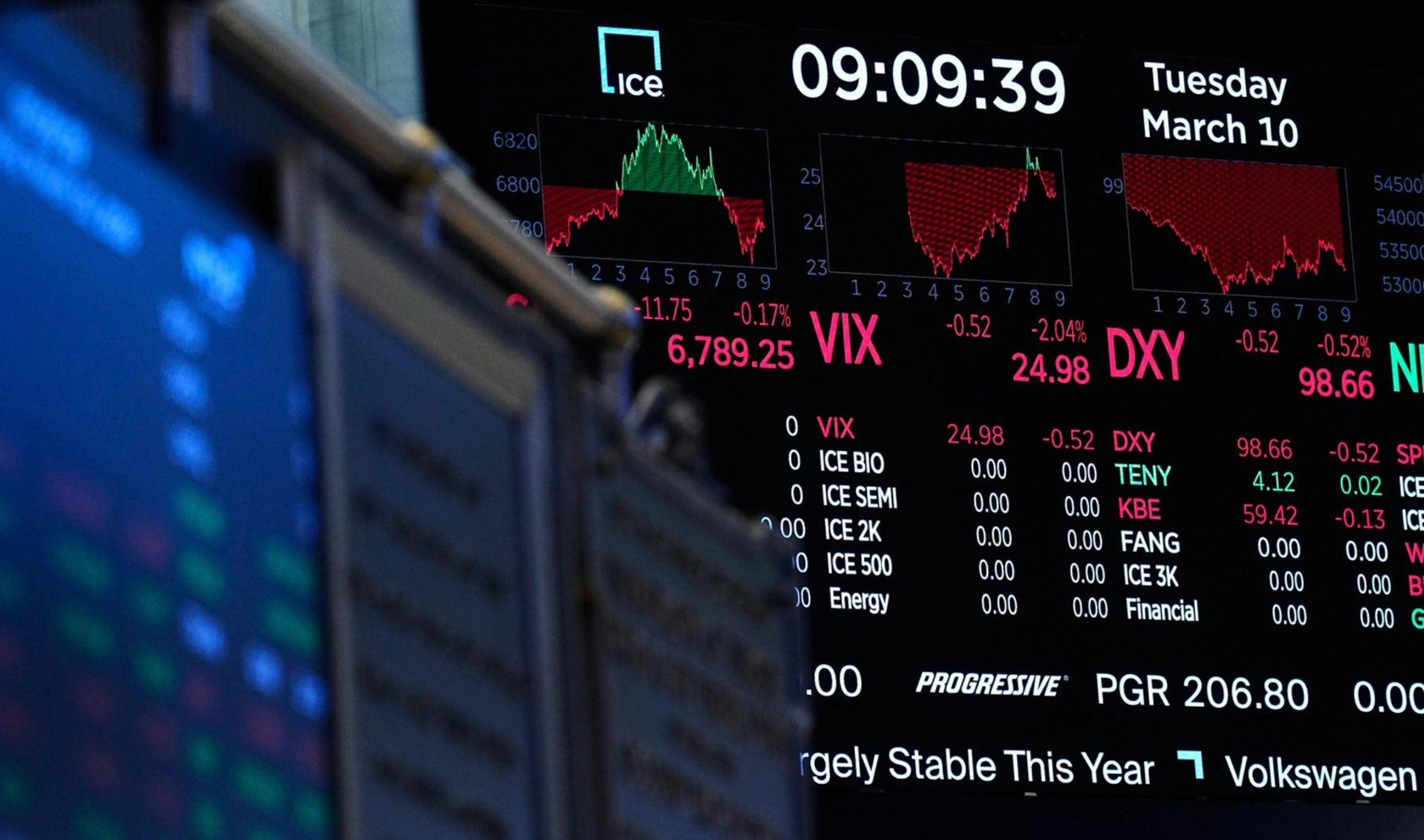
VIX at 19.29, 10-year yield above 5%, bearish sentiment at 25-of-27-week extremes. Fed Chair Warsh speaks today. Here's Monday's full risk framework.
Key Points
- The VIX hit 19.29 Monday morning with the one-day fear gauge up 16.51% to 18.63 — nearly level with spot VIX — a convergence that flags acute event-driven risk rather than slow-moving macro deterioration.
- The 10-year Treasury yield trading above 5% combined with AAII bearish sentiment at 51.4% represents a dual macro-behavioral pressure setup not seen consistently since the 2022 rate-shock cycle.
- Fed Chair Kevin Warsh speaks today, and any hawkish signal on rates would pressure the Nasdaq disproportionately; watch SPX 7,425 as the first support level and 7,350 as the line in the sand.
The number that defines Monday's session is not on a stock ticker — it is 19.29, the VIX reading as of Monday morning, sitting one bad data point or one hawkish Fed sentence away from breaching 20 for the first time in this cycle. Pair that with a 10-year Treasury yield above 5% and retail bearish sentiment at 51.4% — elevated for 25 of the last 27 weeks — and the market structure heading into this week's key events is as fragile as it has been since the 2022 rate-shock era.
What the Fear Gauges Are Actually Saying
The VIX number itself — 19.29 — is important, but the structure around it is more informative than the spot reading. VIX futures settled at 19.450 on the November contract, placing the term structure in contango, while the SKEW index registered 147.14, indicating that options traders are paying an elevated premium for tail-risk protection in the left tail of the distribution. These are not readings you see in a complacent tape.
The most telling data point in the volatility complex is the convergence between the one-day VIX gauge and spot VIX. VIX1D — which measures implied volatility over a single trading session — jumped 16.51% Monday morning to 18.63, nearly identical to the spot VIX of 19.29. The nine-day measure stayed below both. That configuration has a specific meaning: traders are not hedging a generalized multi-week deterioration. They are paying up for protection against a discrete overnight event, which in this case means Tuesday's Nvidia earnings and today's remarks from Fed Chair Kevin Warsh. When short-dated vol converges with medium-dated vol, the market is compressing its entire risk calculus into a 24-to-48-hour window.
The Macro Overhang: Rates and the Fed Chair
The 10-year Treasury yield breaking and holding above 5% is not simply a bond-market story — it is a valuation tax on every growth-multiple stock in the S&P 500 and Nasdaq. The discount-rate math is unforgiving at these levels. A stock that was reasonably valued at 30-times forward earnings with a 4.5% risk-free rate becomes structurally expensive at 5%-plus, particularly when earnings visibility is clouded by governance instability in the sector's bellwether name. This is precisely why the Dow — heavy with financials, industrials, and dividend-payers that benefit from or are insulated against high rates — was up 0.10% in futures Monday morning while the Nasdaq dropped 0.94%.
Kevin Warsh's scheduled remarks today carry unusual weight given the recent sharp repricing of Fed rate-hike expectations. Warsh, who took the chair role after serving as a Fed governor during the financial crisis, has historically leaned toward a tighter-money framework when inflation data is ambiguous. Any signal today that the Fed is not done — or that the committee is reconsidering the pace of any potential easing — would arrive into a market that is already buying VIX1D at near-spot levels. The rate-sensitive components of the Nasdaq, which include not just Nvidia but the cloud infrastructure names that underpin the AI trade, would bear the first and sharpest impact of a hawkish surprise.
The Technical Setup and What Clears It
The S&P 500's technical structure heading into Monday's open reflects a market that survived last week's volatility on the strength of its long-term support, not on the strength of its fundamentals. The rising 200-day moving average and long-term value area held as support near 7,350, absorbing selling pressure through a week that saw the index trade a wide intraday range. The SPX opened Monday down approximately 0.4% — consistent with futures pricing — with 7,425 as the immediate near-term support level. A clean break below 7,425 on volume would open the path to 7,270 and then 7,090, with the visible volume pocket extending back toward the 7,000 round-number level that would represent a psychologically and technically significant retest.
The sentiment data provides context for what a catalyst-driven reversal could look like from these levels, though it does not by itself constitute a buy signal. The AAII survey for the week ending November 11 showed bullish responses at just 30.8%, down from 34.1% the prior week, while bearish responses climbed to 51.4% — a bull-bear spread of –20.6% that has remained below the historical average of +6.5% for 25 of the last 27 weeks. Historically, readings this persistently negative in retail sentiment have preceded sharp recoveries when a clearing event resolves the dominant uncertainty. The problem is that "persistent" is not "perpetual" — the sentiment extreme does not clear itself; a data point has to do it.
The energy market adds a secondary risk variable worth monitoring. Brent crude futures fell 0.37% to $95.49 per barrel Monday morning, with WTI near $88.56, maintaining the spread above $6 that reflects persistent logistical and quality differentials. Oil at these levels is not yet an inflationary emergency, but it is not deflationary relief either — it keeps the Fed's inflation calculus complicated and limits the central bank's flexibility to pivot dovish if growth data softens. For traders who are watching Warsh's remarks today looking for any hint of easing bias, Brent above $95 reduces the probability of getting that signal.
The week's resolution path is binary and time-bound. If Warsh delivers a neutral-to-dovish tone today and Nvidia's Tuesday earnings show the business is running independently of its founding CEO with no guide-down, the conditions for a sharp sentiment-driven bounce are in place — 25-of-27-week bearish extremes are powerful contrarian fuel when the ignition arrives. If either event disappoints, 7,350 on the SPX becomes the defensive line, and a failure there puts the 7,000 level on the table before the end of November. Mark November 17 as the session that resolves the question.
---
The Weekly Investor
Daily market analysis for active traders. Free.