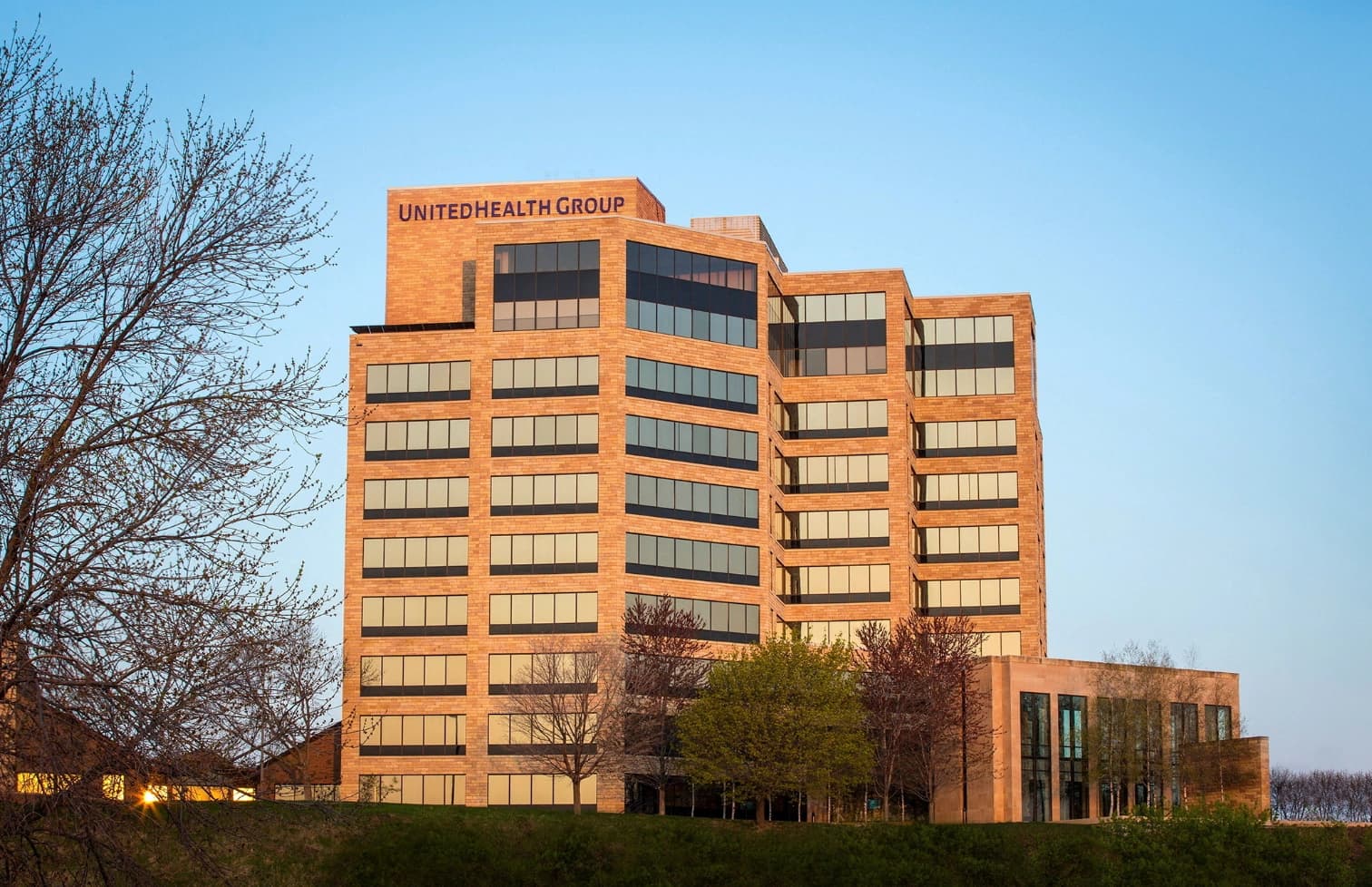
UnitedHealth Q3 Preview: ±6.85% Implied Move, Guidance Is All
UnitedHealth Group reports Q3 2026 with the largest implied earnings move of the day. EPS consensus $4.14, FY guide $19.50–$20.00 — any trim is the risk.
Key Points
- UnitedHealth Group faces Q3 consensus of $4.14 EPS on $111.31B revenue, with options pricing a ±6.85% earnings-day move — the largest implied swing of any major reporter today.
- The 90-day EPS consensus revision was +10.84% heading into the print, meaning expectations have been reset sharply higher and the margin for disappointment is thin.
- Any trim to the $19.50–$20.00 FY2026 adjusted EPS guidance range would likely drive the stock back toward January 2026 lows.
UnitedHealth Group carries the largest implied earnings-day move of any major name reporting today — ±6.85% — and for good reason. The stock has a live fault line running through it: full-year 2026 adjusted EPS guidance of $19.50 to $20.00, with consensus sitting at $19.80 right in the middle of that range. The Q3 number matters. The guidance language matters more. A single sentence from management trimming the top end of that range would be enough to reopen the January 2026 sell-off narrative and send UNH back toward levels that erased months of recovery.
The Expectations Reset Problem
Wall Street has spent the last 90 days revising UNH's Q3 EPS estimate upward by 10.84%. That is not a minor drift — it is a meaningful recalibration of what analysts believe UnitedHealth's managed care and Optum businesses can generate in a quarter where medical cost trends have been the central debate across the entire health insurance sector. The Q3 consensus now sits at $4.14 per share on revenue of $111.31 billion. For context, a year ago UnitedHealth earned $2.92 per share on $113.16 billion in revenue — implying year-over-year EPS growth of 41.8% against a revenue base that is actually expected to shrink by roughly $1.85 billion.
That combination — 41.8% earnings growth on declining revenue — tells you exactly where the pressure point is. The Street is modeling significant margin expansion, driven primarily by assumptions about medical loss ratio improvement. If UnitedHealth's MLR came in worse than expected through the summer months, the EPS math breaks down fast. The company's peers in managed care — Humana, Cigna, Elevance — have flagged elevated utilization in their most recent updates, and that is the single most important read-through for UNH heading into today's print. Any indication that utilization trends did not moderate in July through September will hit both the Q3 actuals and the Q4 implied guidance simultaneously.
The January Scar Tissue
The January 2026 sell-off is not ancient history for UNH shareholders — it is the reference point that every institutional holder has in their risk model right now. The stock dropped sharply on guidance concerns at the start of the year, and the recovery since then has been built on the assumption that the company's FY2026 adjusted EPS range of $19.50 to $20.00 would hold. Consensus at $19.80 sits 50 cents above the floor of that range and 20 cents below the ceiling. There is almost no cushion on the upside relative to where the Street already sits, and meaningful downside if management signals that the range needs to come down.
The risk asymmetry here is notable. If UNH beats Q3 EPS by a modest margin and reaffirms the $19.50 to $20.00 range, the upside reaction is likely muted — the 10.84% upward revision in consensus over 90 days has already priced in a solid quarter. But a guidance cut, even a narrow one that simply removes the top end of the range, would force a full re-rating. The January sell-off showed how quickly institutional holders exit managed care names when the annual earnings algorithm breaks. The options market's ±6.85% implied move — the largest of any reporter today, larger than JPMorgan's ±3.6% and larger than Goldman's ±4.7% — reflects exactly that asymmetric risk profile baked into the current setup.
Reading the Optum Variable
UnitedHealth is not simply a health insurer — Optum, its health services and pharmacy benefit arm, has become the dominant earnings driver and the business that analysts watch most closely for evidence of structural margin durability. In recent quarters, Optum's contribution has buffered insurance-side pressure when medical costs ran hot. The question for Q3 is whether Optum's technology and care delivery businesses continued to scale revenue fast enough to offset any deterioration in the insurance segment's MLR.
Revenue consensus of $111.31 billion for the quarter is actually below the year-ago $113.16 billion, which on the surface looks like a low bar. But the composition matters: if the revenue miss is driven by Optum deceleration rather than insurance segment volatility, the market will read it as a structural problem rather than a cyclical one. Optum Health alone has been targeting significant patient panel expansion, and any slowdown in that metric would raise questions about the medium-term earnings growth algorithm that has supported UNH's premium valuation multiple. CNBC's live bank and healthcare earnings tracker is the fastest source for confirmed actuals as they hit the wire.
The broader market context compounds the pressure. Today's session is already colored by JPMorgan's rare double miss, which is driving a risk-off tone in large-cap financials and creating a skittish backdrop for any name that reports a downside surprise. UNH, as a Dow Jones Industrial Average component and one of the largest positions in many institutional health care funds, has index-level implications if it sells off sharply. A 6.85% decline from Friday's close would represent a significant drag on the Dow's daily performance and would ripple through healthcare ETFs and managed care peers almost immediately.
The Level That Matters
The number to keep in front of you is $19.50 — the floor of UnitedHealth's own FY2026 adjusted EPS guidance. As long as management reaffirms that the full range of $19.50 to $20.00 is intact, the stock has a fundamental anchor even if Q3 actuals disappoint modestly. A reaffirmation of the range, combined with any Q3 EPS print at or above $4.14, would likely trigger a relief rally toward the upper half of the ±6.85% implied range and put the January lows firmly back in the rearview mirror.
The scenario that traders holding UNH long need to game out in real time is a guidance range that gets narrowed downward — say, to $19.50 to $19.75 — rather than outright cut. That kind of subtle trim is how management teams signal deteriorating visibility without triggering a full-scale analyst downgrade wave on the same day. Watch the exact language in the press release around "full-year 2026 adjusted EPS" with the same attention a fixed income trader gives to a central bank statement. The difference between "affirming" and "narrowing" the range could be worth several billion dollars in market cap before lunch. If the guidance is trimmed in any form, the first technical support level to monitor is the January 2026 closing low — a revisit to that level would represent the most significant single-day health care sector event of Q3 earnings season.
The Weekly Investor
Daily market analysis for active traders. Free.