Seven ETFs Die in 48 Hours; VanEck Launches Bitcoin Hybrid
ProShares shuttered seven thematic ETFs in two days as VanEck's new WBMO brings Bitcoin exposure to retail at 0.26% — the ETF graveyard is filling fast.
Key Points
- ProShares liquidated six thematic ETFs in a single day on October 27, with a seventh fund — ProShares Ultra Nasdaq Cybersecurity ETF (UCYB) — also shuttered, paying out $103.71 per share.
- VanEck launched its Wealth Builder ETF (WBMO) on the NYSE the same day at a 0.26% net expense ratio, packaging model portfolios with embedded Bitcoin exposure into a single retail product for the first time.
- With 1,397 ETF products launched globally through May 2026 and closures accelerating, the product cycle is entering a brutal Darwinian phase — watch WBMO's first-week AUM figure as an early read on whether the Bitcoin hybrid model has retail traction.
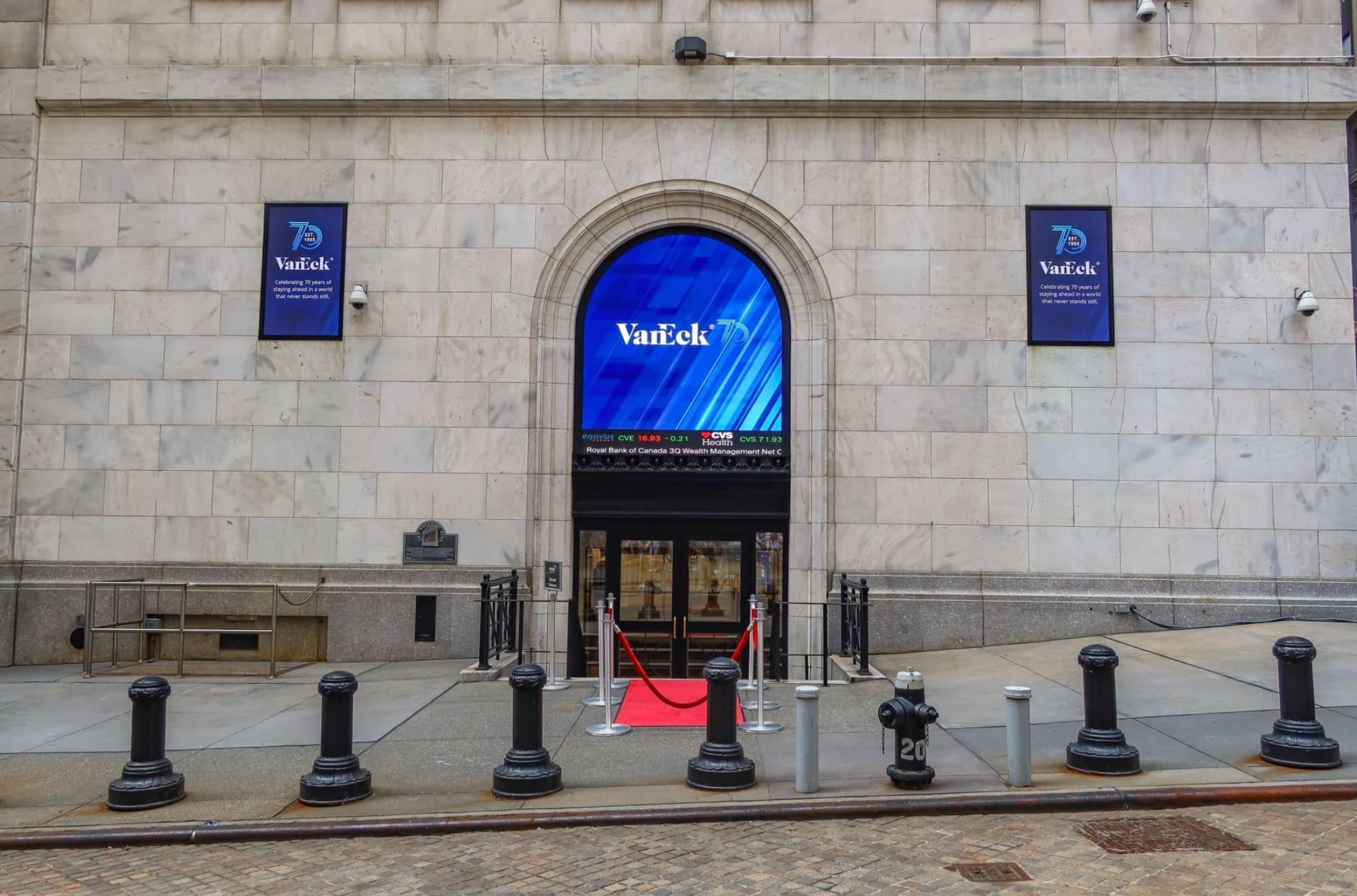
Seven ETFs died in 48 hours. One was born the same morning. The ProShares purge on October 27 — six funds liquidated in a single session — landed on the same day VanEck rang the NYSE bell for its new Wealth Builder ETF (WBMO), a 0.26%-expense-ratio product that packages model portfolios with embedded Bitcoin exposure into a single retail wrapper. The juxtaposition is not accidental: the ETF industry is simultaneously culling the thematic experiments that never found buyers and betting the next growth vector is Bitcoin-integrated multi-asset products aimed at ordinary investors.
The ProShares Purge
Six ProShares funds closed on October 27, spanning the full arc of the thematic ETF boom and bust. The ProShares MSCI Transformational Changes ETF (ANEW) paid shareholders $54.88 per share on liquidation. The On-Demand ETF (OND) returned $33.22. The Supply Chain Logistics ETF (SUPL) paid out $44.78. The Smart Materials ETF (TINT) returned $37.39. The ProShares Metaverse ETF (VERS) — perhaps the most symbolically loaded name on the list given the Metaverse's spectacular fall from venture capital darling to industry punchline — returned $71.47 per share. The Ultra Nasdaq Cybersecurity ETF (UCYB), the lone leveraged product in the group, paid $103.71 per share.
Principal's Quality ETF (PSET) also liquidated in the same window, returning $79.90 per share. Seven funds in 48 hours is not a routine housekeeping event — it is a triage operation. ProShares is cutting products that either never scaled to sustainable AUM levels or drifted so far from institutional relevance that their continued existence was a liability, not an asset. The thematic ETF wave that crested in 2021 and 2022 — built on the premise that granular sector stories like supply chain logistics, smart materials, and the metaverse could sustain independent fund structures — is being unwound in bulk. Robinhood's corporate actions tracker shows these closures processed cleanly, with shareholders receiving cash at NAV, but that's cold comfort for investors who rode these funds down from their launch prices.
The broader closure wave reflects a structural overcorrection in product manufacturing. ETFGI reports a record 1,397 new ETF products launched worldwide through May 2026, with active ETFs leading all categories at 741 launches and equity ETFs adding 423. Leverage Shares topped the launch rankings and is also behind Themes ETF Trust funds that couldn't attract enough capital to survive. The math on ETF economics is unforgiving: a fund needs roughly $50M to $100M in AUM to cover operational costs at typical expense ratios, and thematic products that launched on a narrative rather than a capital commitment rarely get there before the narrative expires.
WBMO and the Bitcoin Hybrid Bet
VanEck's launch of WBMO on the same day ProShares was closing six funds says something deliberate about where the firm sees opportunity. The Wealth Builder ETF wraps VanEck's model portfolios — previously only available to financial advisers via third-party platforms — into a retail product at a gross expense ratio of 0.33%, reduced to 0.26% net after a fee waiver. For a fund-of-funds style product with multi-asset exposure, that's competitive pricing. The kicker is the Bitcoin slice.
VanEck has not specified a target Bitcoin allocation in WBMO's prospectus, which is either a feature or a bug depending on your perspective. It means the firm retains discretion to adjust the BTC weight as market conditions change — giving the product flexibility that a rules-based Bitcoin allocation would not — but it also means investors cannot know precisely what Bitcoin exposure they are buying. What they do know is that they do not need a cryptocurrency exchange account, a hardware wallet, or a seed phrase to access it. For the mass retail channel — specifically, the adviser-distributed investor who wants Bitcoin exposure without the operational friction of direct ownership — that frictionless access is the product's core value proposition.
VanEck oversees approximately $244B in assets, which gives WBMO institutional distribution infrastructure from day one. The firm already runs one of the established spot Bitcoin ETFs, giving it credibility with the crypto-adjacent adviser community. The model portfolio wrapper is a format that has gained significant traction in the ETF industry over the past three years, as advisers increasingly outsource asset allocation decisions to fund managers and use ETFs as the implementation vehicle. Combining that trend with Bitcoin exposure is a logical product evolution — the question is whether the timing is right.
What Traders Watch Next
The WBMO launch lands in a market where Bitcoin ETFs are recovering but still polarized around IBIT. Whether a diversified model-portfolio product with an unspecified Bitcoin sleeve can attract flows when single-asset IBIT is absorbing everything is an open empirical question. First-week AUM is the metric to watch: if WBMO crosses $50M in its first five trading sessions, it signals genuine adviser-channel demand for the hybrid format. Below $25M in week one would suggest the product will face the same AUM treadmill that killed ANEW, OND, and SUPL.
The broader ETF product cycle is entering a Darwinian phase that will likely accelerate into year-end. With 1,397 launches globally through May and the closure pace clearly picking up, issuers are running a brutal survivor selection process in real time. ProShares' willingness to close six funds in a single day — rather than dragging out the process across months — suggests the industry has internalized that slow death is worse than fast liquidation for all parties. For retail traders, the practical implication is straightforward: before entering any thematic or niche ETF with under $200M in AUM, check the issuer's recent closure history. The graveyard is filling fast, and the next wave of liquidations will not send advance notice.
The Weekly Investor
Daily market analysis for active traders. Free.