Nasdaq Futures Turn Red as NVDA Skids 4.6% Pre-Market
Nasdaq 100 futures slip negative as Nvidia drops 4.6% pre-market. VIX at 25.64 and Tuesday CPI loom over Monday's recovery attempt.
Key Points
- Nasdaq 100 futures have slipped -0.13% as of Monday morning, the only major index contract in the red, while Nvidia tumbles 4.58% pre-market on a Jensen Huang controversy.
- Thursday's 5.5% Nasdaq collapse — triggered by Democratic midterm victories and fears of AI regulation slowing data-centre buildout — is still unresolved, with the VIX at 25.64 signaling elevated risk of further large swings.
- Traders should watch NVDA's direction at the 9:30 ET open and Tuesday's October CPI print for the clearest signals on whether this is a dip to buy or a trend to fade.
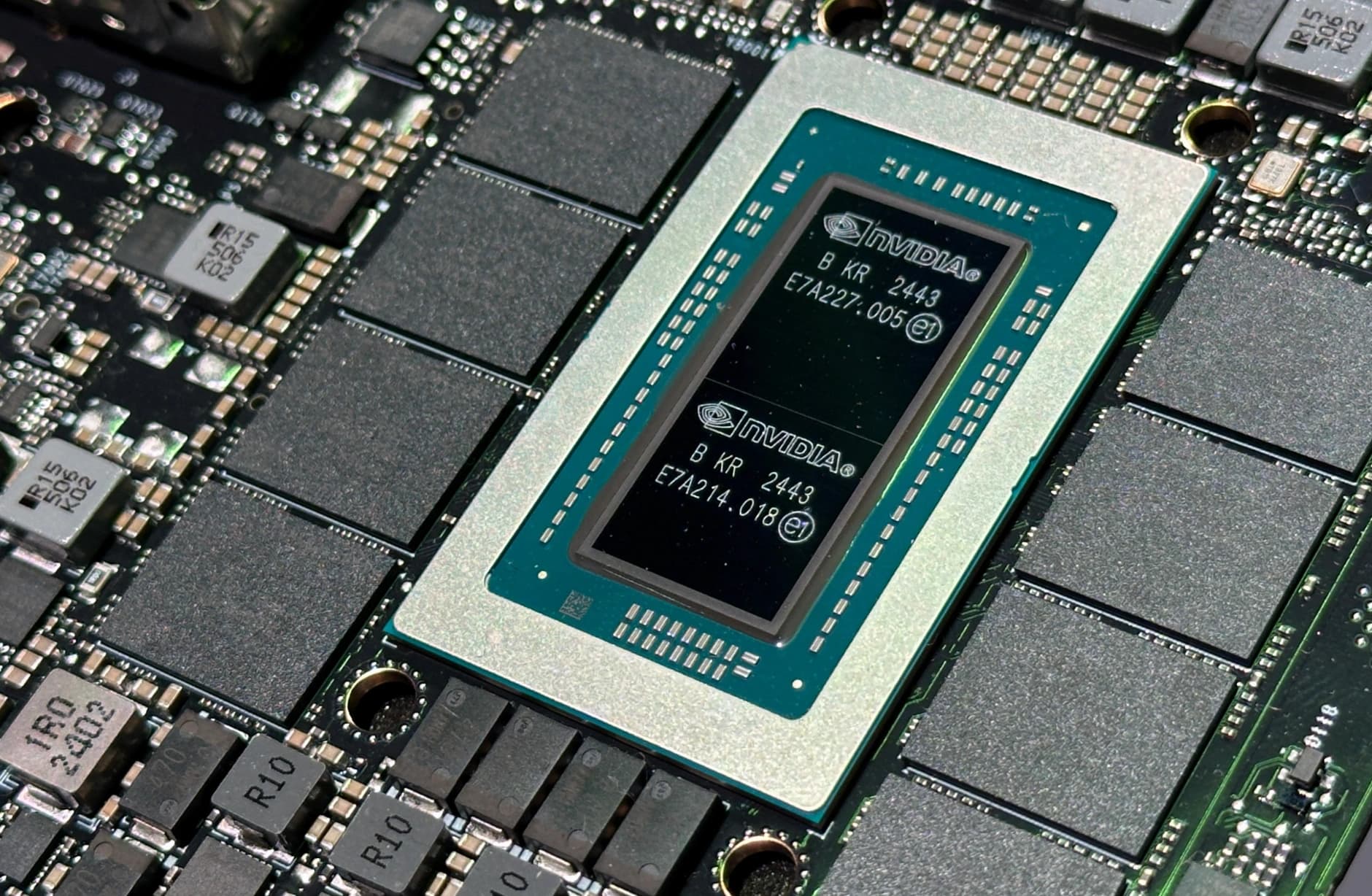
Nvidia is bleeding again. NVDA shares are down 4.58% in pre-market trading Monday morning — erasing most of Friday's hard-fought 2.8% recovery — and the damage is pulling Nasdaq 100 futures into the red at -0.13% even as the Dow adds 0.64% and small-caps surge nearly 1%. The divergence is the story: this is not a broad market recovery, it is a rotation away from the AI trade that powered 2026's first three quarters.
The Split That Changes Everything
The futures board this morning reads like two different markets sharing one open bell. The Russell 2000 is up 0.97%, the Dow is adding 64 basis points, and the S&P 500 is clinging to a +0.47% gain — all three pointing to genuine risk appetite in cyclicals and value. Then there is the Nasdaq 100 at -0.13%, dragged lower almost entirely by the mega-cap AI complex, with Nvidia as the most visible casualty. That divergence — large-cap tech down while everything else climbs — is not noise. It is the market repricing the regulatory risk premium on AI infrastructure spending after the Democrats swept both the House and Senate in Tuesday's midterms.
The political context matters enormously here. Several newly elected Democrats ran explicitly on platforms calling for slower AI deployment and significantly more aggressive federal oversight of data-centre energy consumption and algorithmic systems. Investors spent Thursday digesting what that means for the capex cycle that has been the central thesis of the AI trade: if data-centre buildout slows under regulatory pressure, the direct revenue lines for Nvidia, AMD, and their supply chains compress. The result was the Nasdaq's worst single session in over a year — a 5.5% plunge on Thursday that the Yahoo Finance live markets desk tracked in real time as selling accelerated through the afternoon.
Friday's partial bounce — Nasdaq +1.1%, S&P 500 +0.3%, Dow -0.5% — looked encouraging on the surface but closed with Nvidia at $186.69 on 139.2 million shares, a volume figure that tells you institutions were not buying conviction, they were managing exposure. Monday's pre-market action is now confirming that read. NVDA is tagged at $178.09 implied, and the Jensen Huang controversy — details of which surfaced over the weekend — is adding an idiosyncratic layer of headline risk on top of an already stressed technical picture.
The VIX Is Not Lying
The fear gauge is the most honest data point on the board right now, and it is telling traders to stay defensive. The VIX opened Monday at 27.68 — well above Friday's close of 25.64 — before pulling back toward the mid-25 range. The intraday range of 23.47 to 27.76 is itself instructive: the compression from the morning spike suggests some stabilization, but at a VIX above 25, options markets are still pricing daily S&P 500 moves of roughly 1.6%, nearly double the 0.85% implied by a VIX in the mid-14s that prevailed through September.
Context matters here. The VIX's 52-week range runs from 13.38 to 35.30. The current reading of 25.64 sits squarely in the zone associated with genuine institutional stress — not panic, but not complacency either. The last time the VIX sustained levels above 25 for more than a week, the S&P 500 ultimately found its footing only after a clear macro catalyst resolved the uncertainty. Right now, that catalyst is Tuesday's October CPI print. Historical patterns following the ten largest single-day S&P 500 drawdowns of the past four decades show meaningful reversals are common — but they tend to require a macro trigger to cement the turn, not just a quiet weekend.
Adding to the complexity, the macro backdrop is not clean. October payrolls came in at a scorching +165,000 against consensus expectations of roughly 60,000, unemployment ticked down to 4.1%, and fed funds futures are now pricing a 78% probability of a December rate hike. That is a Federal Reserve that has no obvious incentive to pivot dovish and backstop equity markets. Three Fed speakers — Bowman, Goolsbee, and Barkin — are on the calendar today, and any hawkish commentary landing while Nasdaq futures are already negative could accelerate the intraday selling. CNBC's live market coverage flagged all three appearances as potential volatility triggers heading into Monday's session.
What the Open Decides
The 9:30 ET bell is binary. If Nvidia opens at the implied -4.6% and holds that level or stabilizes, the broader market can likely absorb the damage — the Russell 2000 and cyclical rotation provide a cushion, and the S&P 500 at 7,421 futures has room to operate. But if NVDA breaks below $175 on heavy volume and drags AMD and Micron lower with it — AMD closed Friday at $447.82 and MU at $689.91, both of which surged 11% and 5.1% respectively on Friday — then the Nasdaq 100 is looking at a test of the 26,500 level, approximately 2% below current futures pricing.
The semiconductor rotation is worth watching as a secondary tell. ASE Technology is up 5.5% and United Microelectronics is up 3.7% in pre-market, suggesting some money is moving down the chip supply chain rather than exiting semiconductors entirely. That is a nuanced signal: traders are not abandoning the chip sector, they are repositioning within it toward names with less direct AI-capex exposure. If that rotation holds through the open and into Tuesday, it suggests the market is re-rating AI infrastructure risk rather than pricing a broader tech bear market.
The single hardest date on the calendar is tomorrow, November 10, when the Bureau of Labor Statistics releases October CPI and core inflation data. Given that payrolls already blew past estimates by more than 100,000 jobs, a hotter-than-expected CPI reading would cement the December hike at something approaching certainty and put the equity multiple under simultaneous pressure from both the regulatory front and the rates front. Watch the Cboe VIX board at 9:35 ET — if the VIX spikes above 28 within the first five minutes of trading, treat it as a signal the market is not done repricing. The line in the sand for the S&P 500 is 7,300: a close below that level would mark a full round-trip of November's recovery attempt and open the door to a retest of October lows.
The Weekly Investor
Daily market analysis for active traders. Free.