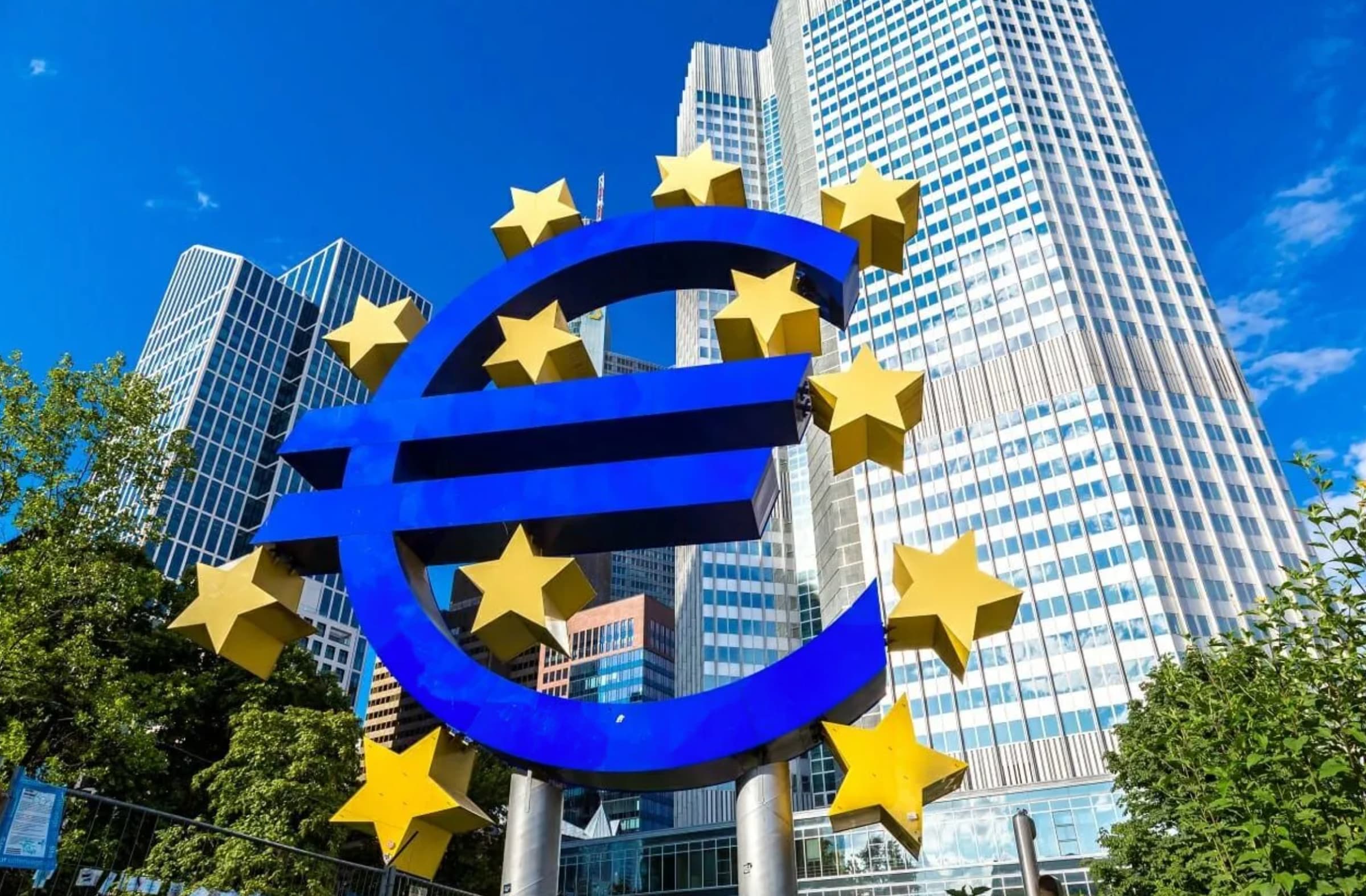
ECB Holds at 2.50%, But December Is Live
ECB holds rates at 2.50% Thursday as expected, but 64 of 73 economists see a December hike. Lagarde's 9:45 AM ET presser is the market event.
Key Points
- The ECB holds its deposit rate at 2.50% Thursday — the widely expected outcome — but 64 of 73 economists surveyed see a 25-basis-point hike at the December meeting.
- Lagarde's press conference at 9:45 AM ET is the actual market event: any signal toward a December pause hammers EUR/USD, while hawkish language on inflation sustains the euro's recent bid.
- Watch EUR/USD around the 1.0820–1.0850 range for the initial Lagarde reaction, with French fiscal risk the wildcard that could prompt an unexpected dovish tilt.
Seventy of seventy-three economists got this right: the European Central Bank held its deposit rate at 2.50% Thursday, keeping the main refinancing rate at 2.65% and the marginal lending rate at 2.90% — a rate structure unchanged since September 16, when the ECB hiked by 25 basis points. The hold itself is not the story. What ECB President Christine Lagarde says at 9:45 AM ET is.
The December Hike Setup
The ECB's September hike — which brought the deposit rate to its current 2.50% — was not a one-and-done signal. Sixty-four of the 73 economists surveyed ahead of Thursday's decision see another 25-basis-point move in December, which would bring the deposit rate to 2.75%. The peak rate question is where the real divergence sits: 40 of 70 economists see 2.75% as the terminal rate; 24 of 70 see 3.00%. That split means the December hike is nearly consensus, but the path beyond it is genuinely contested — and Lagarde's language today will either narrow or widen that range.
The data backdrop gives the hawks plenty of ammunition. Eurozone consumer confidence for October came in at the consensus -17.9, unchanged from the prior reading — negative, but stable enough that the ECB can't point to a deteriorating demand picture as a reason to pause. Industrial confidence for September was -3.8, and services sentiment was 6.1, suggesting the services sector — historically the stickier inflation engine in Europe — is holding up despite tighter monetary conditions. The Eurozone Economic Sentiment Indicator for October, also due Thursday, was last at 97.9. A print that stays near or above that level reinforces the case for Lagarde to maintain a hawkish tilt.
The structural argument for continued tightening is straightforward: the ECB began hiking later than the Fed, peaked at a lower rate, and is now operating in an environment where energy prices remain elevated and services inflation is still well above target. Lagarde does not have the luxury of declaring victory that Fed Chair Warsh is also not yet claiming across the Atlantic. The question is whether external risks — specifically the French fiscal situation — give her political cover to soften guidance even if the underlying inflation data argues against it.
The France Problem
Moody's recent action removed some of the most acute near-term French fiscal risk, and that matters to the ECB because a French sovereign stress event would complicate any further tightening. France's budget trajectory remains a live issue heading into 2027, and the spread between French OAT 10-year yields and German Bunds — a real-time barometer of that stress — will be trading in the background as Lagarde takes questions Thursday. Any significant widening in OAT-Bund spreads since the September meeting will almost certainly surface in the press conference Q&A, where Lagarde has historically been forced to either minimize the concern or acknowledge fragmentation risk.
The tension for the ECB is institutional: the Transmission Protection Instrument exists precisely for scenarios where spread widening threatens to undermine the uniform transmission of monetary policy. If France's fiscal dynamics push OAT-Bund spreads wide enough that the TPI becomes relevant, the ECB faces a direct conflict between its inflation mandate — which argues for more hikes — and its stability function, which argues for restraint. Lagarde's handling of that question today could move EUR/USD more than the rate decision itself. A comment that even hints at TPI deployment concern would be interpreted as a soft pause signal, and the euro would sell off accordingly.
The BoJ adds a secondary FX dimension to Thursday's session. The Bank of Japan is meeting October 29–30, with its Statement on Monetary Policy due Friday morning Tokyo time. The BoJ is widely expected to hold at 1.25%, and Tokyo CPI for October — already released — supports that: headline Tokyo CPI came in at a prior of 2.7% with consensus at 2.6%, Tokyo core CPI consensus at 2.6% against a 2.7% prior, and the ex-food-and-energy measure showing a consensus of 2.7% against a 3.0% prior. All three are trending down, giving Governor Ueda no urgency to move. But a BoJ hold Friday combined with a hawkish Lagarde Thursday keeps EUR/JPY bid and adds further complexity to dollar dynamics heading into Friday's U.S. data follow-through.
What Traders Watch Next
The EUR/USD setup into Lagarde's 9:45 AM ET press conference is the most actionable cross-asset trade of the European session Thursday. The pair needs to hold above 1.0820 for the current ECB hike cycle narrative to remain intact. A hawkish Lagarde — one who explicitly signals December as "likely" and declines to soften guidance on French fiscal concerns — would push EUR/USD toward 1.0870–1.0900. A dovish surprise, whether driven by France commentary or a more cautious inflation outlook, breaks 1.0820 and targets 1.0760 in the near term.
The wrinkle is timing. Lagarde's press conference begins at 9:45 AM ET — 75 minutes after the U.S. GDP and PCE data hits. By the time she steps to the podium, the dollar will already have made a significant move based on the BEA prints. A hot U.S. GDP and core PCE number strengthens the dollar broadly, creating headwinds for EUR/USD even if Lagarde is hawkish. The most bullish EUR/USD scenario requires a soft U.S. data print — GDP below 3.0% or core PCE at 0.2% — combined with a hawkish Lagarde. The most bearish scenario is a U.S. upside surprise followed by a Lagarde press conference that hints at caution on further hikes. In that scenario, EUR/USD could see 1.0740 tested before the London close.
Yahoo Finance's live Fed coverage has documented how quickly cross-asset positioning shifted after Wednesday's FOMC statement — the same dynamic applies to Lagarde Thursday, multiplied by the fact that U.S. data has already re-priced the dollar before she speaks. The specific level to mark: EUR/USD at 1.0800 is the line between the ECB hike cycle story remaining credible and the market beginning to price a December pause. Watch that handle through the 10 AM ET hour.
The Weekly Investor
Daily market analysis for active traders. Free.