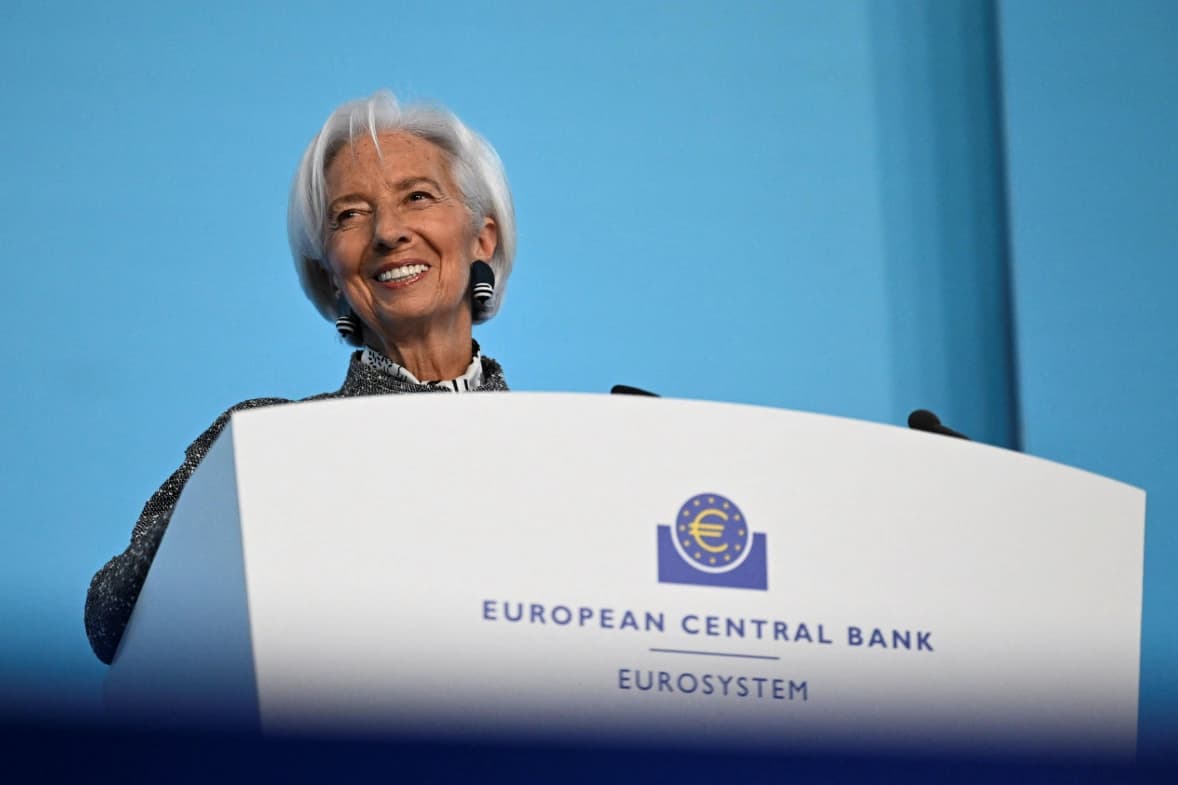
ECB Accounts Reveal Hawkish Tilt as EUR/USD Tests Key Levels
ECB September meeting accounts show inflation concern persists despite weak growth. EUR/USD near 1.1240 after hitting 17-month low. What traders must watch before Oct. 29.
Key Points
- The ECB's September meeting accounts, released today, show staff projections holding HICP inflation at 3.0% for 2026 — still 100 basis points above the ECB's 2% target — keeping a hawkish policy bias firmly in place heading into the October 29 decision.
- EUR/USD is trading near 1.1240–1.1260 after hitting a 17-month low of 1.1161 on October 5, with the dollar's strength driven by the Fed's decisively hawkish posture and a U.S. economy running far hotter than Europe's.
- The October 29 ECB rate decision, arriving the same day as U.S. Q3 GDP, September PCE, and the Fed's own rate announcement, creates a binary event-risk collision that could define the EUR/USD trend into year-end.
The European Central Bank released its September meeting accounts at 12:30 BST today, revealing policymakers who remain acutely aware that eurozone inflation is still 100 basis points above their 2% target even as the economy delivers GDP growth of less than 1% in 2026. EUR/USD is trading near 1.1240 this morning, attempting a modest recovery from the 17-month low of 1.1161 struck just three days ago — but the structural pressure keeping the euro on the back foot has not changed.
The ECB's Difficult Arithmetic
The September staff projections embedded in today's accounts frame the ECB's problem with uncomfortable precision. HICP inflation is projected at 3.0% for 2026, 2.5% for 2027, and 2.1% for 2028 — meaning the ECB doesn't see inflation returning to target for more than two years, even under its baseline assumptions. Core inflation tells a similarly stubborn story: 2.5% in 2026, rising to 2.6% in 2027 before finally easing to 2.3% in 2028. These are not projections that give the Governing Council comfortable cover to begin easing, yet the growth backdrop makes aggressive further tightening a genuinely dangerous proposition.
GDP growth of just 0.9% for 2026 — with quarterly readings of only 0.4% to 0.6% in Q2 — leaves the eurozone walking a narrow ledge between stagnation and mild expansion. The September composite PMI at 53.1 was a genuine positive surprise against the 51.5 forecast, and the services reading of 53.0 confirms that the services sector, which the ECB watches most closely for wage-driven inflation, remains in solid expansion. Manufacturing at 52.7 is also above the neutral 50 level, which reduces the immediate recession risk that was dominating the conversation earlier this year. Unemployment sitting near 6.2% — broadly stable — gives policymakers no particular signal from the labor market in either direction. The ECB is threading a needle: too much inflation to cut, too little growth to hike aggressively. The result is an extended hold that leaves the real policy rate deeply negative when adjusted for current inflation, and that negative real rate is precisely what is pressuring the euro against a dollar backed by 3.75%–4.00% nominal rates.
The accounts are also likely to reflect continued internal tension between the growth-focused doves — predominantly from southern and eastern member states with higher debt burdens — and the inflation-focused hawks led by the Bundesbank and their northern European allies. That fault line has not closed. If anything, the upward revision to U.S. core PCE and the Fed's confirmed hawkish trajectory is giving ammunition to ECB hawks arguing that global inflation dynamics remain more persistent than the baseline assumes, and that premature dovish signaling would risk a disorderly repricing of eurozone inflation expectations.
The Dollar's Structural Advantage
The EUR/USD chart tells the story of diverging monetary cycles with remarkable clarity. The pair's drop to 1.1161 on October 5 — the weakest print since May 2025 — came directly in the wake of data and Fed communications that widened the U.S.-Europe policy rate differential to its largest gap in the current cycle. The Fed sits at 3.75%–4.00% with its dot plot signaling 4.1% by year-end. The ECB's current rate structure, while elevated by historical standards, cannot match that nominal yield advantage, and until it can — or until U.S. growth visibly decelerates — the dollar holds the structural upper hand.
DXY near 101.9 is important context for anyone trading the euro. The index touched 102.53 earlier this year, and the gap back to that high is narrow enough that a single hot U.S. data point — specifically the October 14 CPI print — could close it in a session. ING's currency team has noted that the risks for the dollar remain skewed to the upside into year-end, a view that is difficult to argue with given the Fed's explicitly hawkish posture versus an ECB that is on hold and an economy growing at less than 1%. For EUR/USD longs, the burden of proof is enormous: you need U.S. inflation to undershoot, U.S. growth to wobble, and the ECB to surprise hawkishly — all simultaneously.
The 30-year U.S. Treasury yield at its highest level since 2002 is another headwind for the euro that operates independently of the ECB. When U.S. long-end yields rise to those extremes, global capital allocators rotate toward dollar-denominated assets for yield, pulling capital from European fixed income and equities alike. That capital flow dynamic reinforces the dollar at both the short and long end of the interest rate spectrum, squeezing the euro from multiple angles at once. The eurozone's relatively weak growth trajectory — 0.9% in 2026 against the U.S. GDPNow estimate of 3.7% — makes that rotation story even more compelling for institutional allocators who have the flexibility to move.
What Traders Watch Next
October 29 is the date that demands a hard position review. The ECB's rate decision arrives the same day as the U.S. Q3 GDP advance estimate, September PCE, and the Federal Reserve's own rate announcement — a four-way data and policy collision that has no precedent in the current cycle and could move EUR/USD by 200 pips or more depending on the sequencing and direction of surprises. The ECB decision comes first, during European trading hours; the U.S. data hits at 8:30 AM ET; the Fed decision at 2:00 PM ET. Traders who are flat into that day are making a conscious choice; those who are not flat need a precise stop-loss framework in place well before October 28.
Before October 29, the October 14 U.S. CPI print is the most important near-term input for the EUR/USD trade. A core MoM reading above consensus 0.2% — say 0.3% — would likely push DXY back toward the 2026 high of 102.53 and pressure EUR/USD toward the 1.1100 handle, potentially taking out the 17-month low in the same session. A soft 0.1% print would give the euro room to recover toward 1.1320–1.1350, but that recovery would be renting, not owning — because the structural rate differential doesn't close on a single CPI undershoot. Eurozone traders should also monitor the Bank of England's October 28 decision at 11:00 GMT, where the BoE holds at 3.75%; any deviation from that hold or a surprisingly hawkish statement would ripple into euro-sterling crosses and complicate the EUR positioning picture further.
The ECB's next rate decision on October 29 is where short-term traders need to focus. The critical level on EUR/USD is 1.1161 — the October 5 low. A confirmed break and weekly close below that level would open the path toward 1.1050 and shift the technical picture from "consolidating in a range" to "trending lower with momentum." Conversely, a recovery and hold above 1.1280 into next week keeps the range structure intact and reduces the urgency for aggressive short positioning. The trade setup is asymmetric: the downside is a well-defined structural trend backed by rate differentials and growth divergence; the upside is a data-dependent relief rally in a dollar bull market.
The Weekly Investor
Daily market analysis for active traders. Free.