CoreWeave Surges 25% on $132B Backlog, AMD Catches the Rotation
CoreWeave stock jumped 24.71% on 168% revenue growth and a $132.5B backlog. As NVDA craters, AMD and AVGO catch the AI rotation trade Thursday morning.
Key Points
- CoreWeave reported Q3 revenue of $3.66 billion, up 168% year-over-year, with a record contracted backlog of $132.5 billion — triggering a 24.71% single-session surge on volume of 165.1 million shares.
- The Nvidia board crisis is accelerating a rotation into NVDA alternatives, with AMD up 3.9% and Broadcom up 3.0% in Thursday premarket trading as institutional money seeks AI infrastructure exposure without the governance risk.
- Traders should watch whether CoreWeave can hold above $60 on Thursday's open, as a sustained move above that level on strong volume would confirm institutional accumulation rather than a one-day event-driven pop.
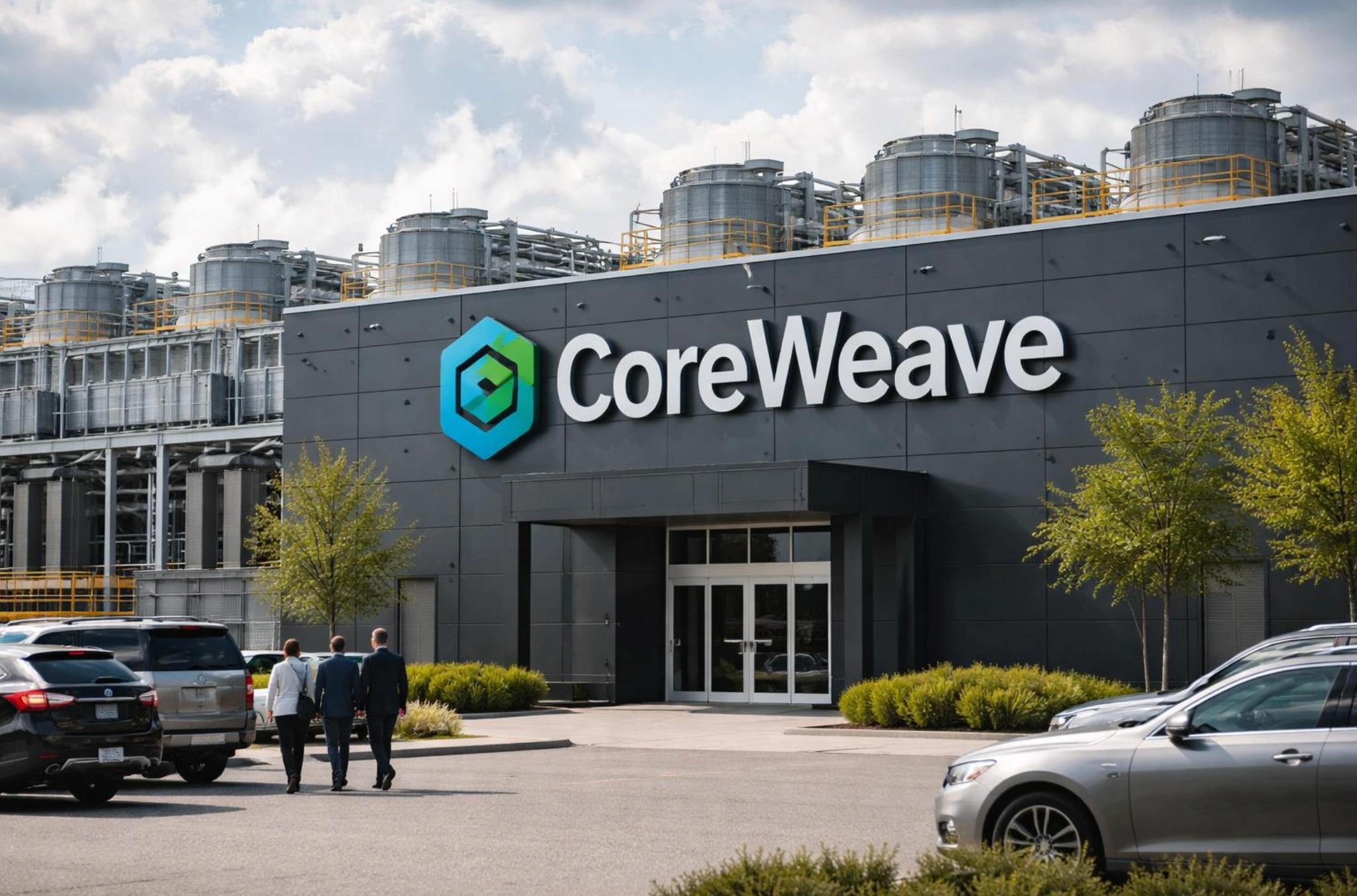
CoreWeave posted $3.66 billion in third-quarter revenue — up 168% year-over-year — and disclosed a contracted backlog of $132.5 billion, the largest in the company's history, sending CRWV shares up 24.71% to $60.77 on volume of 165.1 million shares Wednesday. The result didn't just validate CoreWeave's own investment thesis; it handed the entire AI infrastructure sector a demand confirmation at precisely the moment Nvidia's governance crisis is forcing traders to rethink how they own the AI trade.
The Numbers Behind the Pop
A 168% revenue increase is not analyst-pleasing outperformance — it is a company growing at a pace that compresses the multiple debate into near-irrelevance for momentum-oriented traders. CoreWeave's $3.66 billion in Q3 revenue arrived against a backdrop of persistent skepticism about whether hyperscaler AI spending would actually translate into recognizable revenue for the picks-and-shovels layer of the infrastructure stack. Wednesday's report settled that argument decisively, at least for one quarter. The $132.5 billion backlog figure is the more strategically significant number — it represents contracted future revenue, meaning demand visibility that extends well beyond the current fiscal year and locks in customer commitments before competitors can respond.
Volume of 165.1 million shares on a market cap of $26.88 billion is a turnover ratio that signals genuine institutional participation, not retail speculation. At Wednesday's closing price of $60.77, CoreWeave traded more than 6x its float-adjusted average daily volume. That kind of participation doesn't happen without large funds establishing or meaningfully expanding positions. The question for Thursday's session is whether that institutional buying continues on the open or whether profit-taking into the Nvidia-driven risk-off tone caps the move. Given that Nasdaq 100 futures are down 0.83% as of pre-market Thursday, some giveback on CRWV is the base case — the test is whether dip buyers emerge at or above the $55 to $57 range, which represents approximately 10% below Wednesday's close.
The broader context for CoreWeave's quarter is the sustained pace of data center capital expenditure among the hyperscalers. Microsoft, Google, and Amazon have each disclosed multi-year AI infrastructure commitments running into the hundreds of billions of dollars collectively. CoreWeave sits directly in the path of that spending as a specialized GPU cloud provider — and the $132.5 billion backlog figure suggests it has captured a durable share of that pipeline. Wednesday's print was not a one-quarter anomaly; it was the third consecutive quarter of triple-digit revenue growth for the company.
The Rotation Trade Taking Shape
The Nvidia board crisis has created an acute tactical problem for large funds that need AI infrastructure exposure but cannot hold NVDA through a governance event of this magnitude with earnings five days away. The rotation is visible in real time: AMD gained 3.9% in premarket Thursday and Broadcom added 3.0%, while Nvidia was down 6.3% in the same window. CoreWeave, Nebius Group, and ARM Holdings are also catching money in motion — Nebius was up 15.44% and ARM up 12.05% Wednesday, both on volume that suggests something more than sympathy moves.
The rotation logic has limits that experienced traders need to hold in mind. AMD's GPU roadmap, while credible, does not replicate Nvidia's CUDA ecosystem dominance or its data center revenue concentration. Broadcom's AI exposure is real but structurally different — weighted toward custom silicon and networking rather than general-purpose GPU compute. CoreWeave itself is a customer of Nvidia hardware, not a competitor, which means its backlog is partly contingent on Nvidia's ability to maintain supply chains and product delivery timelines regardless of who sits in the CEO chair. If the Nvidia governance crisis deepens and hardware supply becomes a concern — an unlikely but non-zero risk — CoreWeave's backlog could face execution headwinds that investors are not currently pricing.
ARM Holdings deserves specific attention in this rotation context. Wednesday's 12.05% move to $203.36 on volume of 6.8 million shares reflects something beyond a sympathy trade. ARM's architecture underlies an expanding share of AI inference chips being designed by Apple, Qualcomm, and several hyperscaler custom silicon programs. As the market reassesses concentration risk in the Nvidia stack, ARM's licensing model — which provides revenue regardless of which company wins the chip design competition — looks increasingly attractive as a structural hedge within AI portfolios.
What the CoreWeave Move Tells Us About the Broader AI Trade
Wednesday's session produced a paradox that Thursday's trading will begin to resolve. The S&P 500 rose 1.31% and the Nasdaq 100 jumped 2.28% on the back of CoreWeave's earnings — a broad AI demand validation that should, in theory, be unambiguously bullish for the sector. Then, within hours, the Nvidia board story broke and reversed the entire overnight tape. The VIX, which had fallen to 17.49 on Wednesday — a signal of reduced fear — opened Thursday at 18.81 and was sitting at 18.44 as of the morning dispatch, well above the low-fear readings that accompanied October's market strength.
The divergence between the fundamental signal — CoreWeave's $132.5 billion backlog screaming that AI infrastructure demand is real and durable — and the immediate price action driven by governance risk at Nvidia is the central tension every AI investor is navigating Thursday. Market data as tracked by Bloomberg shows Wednesday's total volume at 14.74 billion shares, well below the 20-session average of 18.68 billion — meaning the Nasdaq's 2.28% rally happened on thin participation, which reduces its technical credibility as a trend signal. The Nasdaq's internal data confirmed the problem: 77 new 52-week highs but 159 new 52-week lows, a divergence that indicates the rally was narrow and concentrated rather than broad-based.
For CoreWeave specifically, the forward setup into year-end depends on two variables: whether the Nvidia crisis resolves quickly enough to restore risk appetite in AI infrastructure broadly, and whether CRWV's Q4 guidance — once released in full — can support a sustained multiple above its current market cap of $26.88 billion. With $132.5 billion in contracted backlog, the revenue visibility argument is strong. The execution risk is in converting that backlog into margin-positive delivery at scale, a challenge every high-growth infrastructure company faces as it transitions from land-grab phase to operational maturity. Watch $60.77 as the reference point: a Thursday close above that level on healthy volume signals the institutional accumulation thesis is intact, while a close below $55 would indicate the Nvidia-driven risk-off environment is overriding even the strongest fundamental print of the AI cycle so far.
The Weekly Investor
Daily market analysis for active traders. Free.