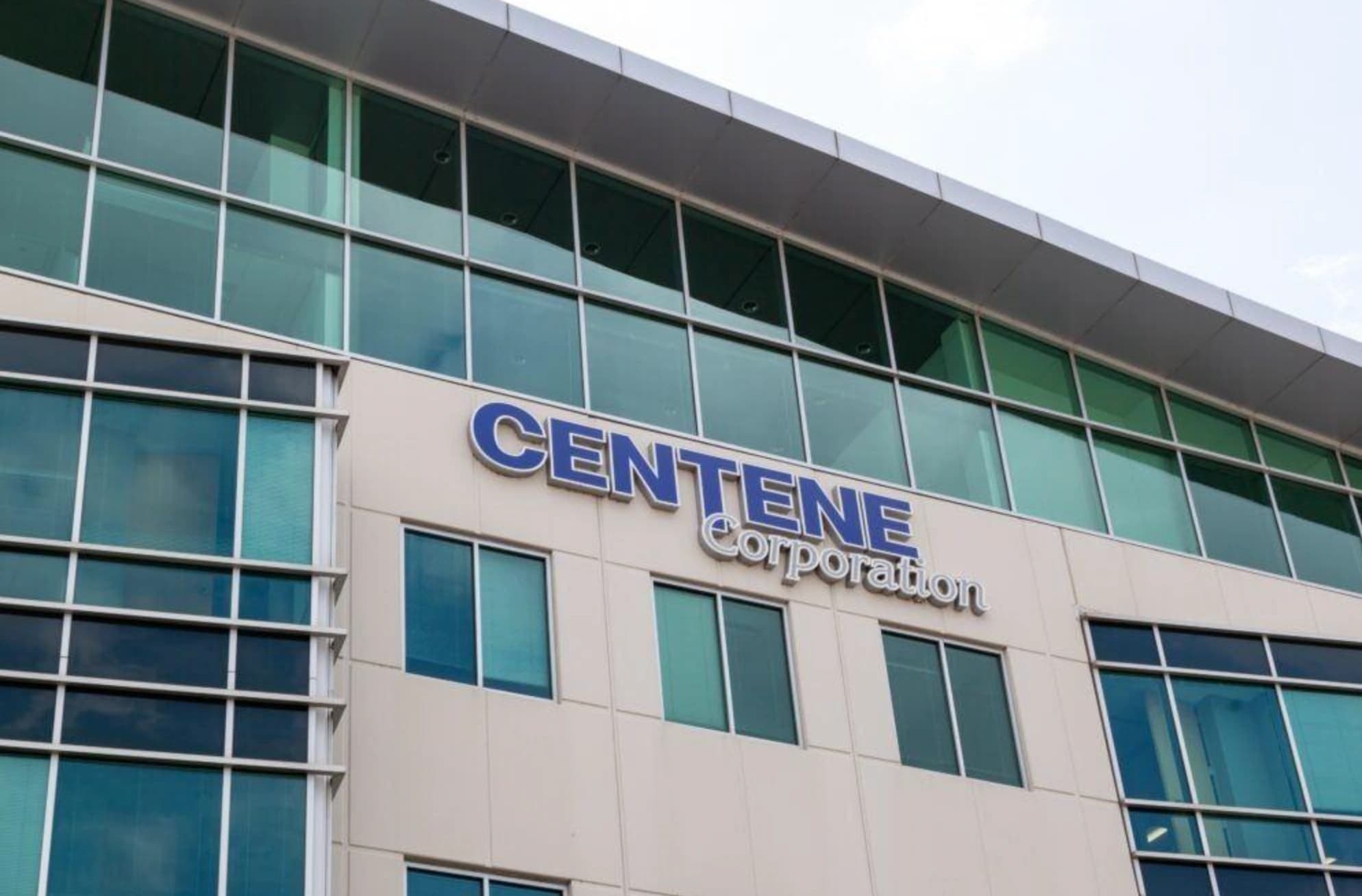
Centene Crushes Q3: $50.6B Revenue Smashes Estimates
Centene Q3 revenue hits $50.6B vs $47.1B estimate, EPS beats 5.8x consensus. Full-year EPS guidance raised $0.40 to above $5.20.
Key Points
- Centene reported Q3 revenue of $50.647 billion against a $47.11 billion consensus estimate — a $3.5 billion upside surprise representing a 7.5% beat.
- A 92.7% health benefits ratio in Q3, driven by Medicare outperformance, enabled management to raise the full-year HBR midpoint by 15 basis points to 90.75% and lift EPS guidance by $0.40.
- Traders should watch whether today's print triggers a round of upward estimate revisions across the managed care sector, particularly at Humana and Molina, which carry similar Medicare exposure.
Centene posted Q3 revenues of $50.647 billion this morning — nearly $3.5 billion above the $47.11 billion Wall Street consensus — and raised its full-year adjusted diluted EPS guidance by $0.40 to greater than $5.20. The EPS print itself, $0.58 adjusted, looked modest in isolation, but it ran 480% above the $0.10 consensus estimate, a discrepancy that reflects how badly the Street had modeled the quarter and how sharply sentiment on managed care has turned.
The Number That Actually Matters
The health benefits ratio is the single most important operating metric in managed care, and Centene's 92.7% consolidated HBR for Q3 came in better than feared. The HBR measures how much of every premium dollar flows out the door as claims — lower is better for the operator, though the political optics in healthcare mean management rarely celebrates the figure publicly. Consensus had braced for a number closer to 93.5% given the ongoing Medicaid redetermination pressure that has plagued the sector throughout 2025 and into 2026. Centene's Medicare segment was the specific outperformer, and that matters enormously for the full-year guide.
Management translated that Q3 outperformance into a durable revision: the full-year HBR midpoint improved by 15 basis points to 90.75%. For a company running nearly $200 billion in annualized revenue, 15 basis points of HBR improvement is not cosmetic. It flows directly into pretax income at scale, and it explains why the adjusted EPS guidance floor moved from above $4.80 to above $5.20 — a $0.40 raise on a number the Street had been quietly cutting for most of the year. GAAP EPS guidance moved to greater than $3.46.
The revenue beat deserves its own analysis. A $3.5 billion upside surprise on a $47 billion estimate is not a rounding error or a timing shift — it represents genuine membership growth and premium revenue coming in ahead of what the actuarial models predicted. Centene has historically been the largest Medicaid managed care organization in the United States by membership, and the Medicaid redetermination cycle that began in 2024 was expected to erode that base materially. Today's print suggests the attrition has either slowed or been replaced by Medicare and commercial membership at a faster clip than modeled.
Why the Street Got It So Wrong
The $0.10 EPS consensus against a $0.58 actual print is a five-times miss in the wrong direction for anyone short the stock or underweight the name. The divergence traces back to a wall of negative sentiment that built around managed care through most of 2025, when elevated post-pandemic healthcare utilization, Medicaid redeterminations, and CMS rate pressures created a genuine earnings headwind across the sector. Analysts who had repeatedly cut numbers were reluctant to rebuild models aggressively without hard evidence that utilization was normalizing. Centene just provided that evidence.
The Medicare segment is the critical variable. CMS finalized its 2027 Medicare Advantage rate notice in April, and the industry broadly received better-than-feared increases. Centene's Q3 HBR outperformance in Medicare suggests those rate increases are already flowing through to the P&L more favorably than models assumed, and that medical cost trend in that population — which had been the key bear thesis — has not accelerated into year-end at the rate feared. That is a read-through for every other MA-heavy insurer reporting over the next two weeks.
The SG&A ratio of 6.5% also held discipline. Revenue scaling without a corresponding SG&A blowup is exactly what long-side investors wanted to see. When a company posts a 7.5% revenue beat and simultaneously holds operating cost ratios flat, operating leverage compounds the earnings upside — which is precisely what the guidance raise reflects.
What Traders Watch Next
The biggest movers in today's session include Surgery Partners at +47% on its buyout and Range Resources at +15% on the EQT deal — but Centene's move carries broader sector implications that neither of those events does. Managed care stocks have been among the most contentious longs in healthcare for 18 months, and a clean beat of this magnitude from the sector's largest Medicaid operator should force capitulation from underweight institutional positions. The question is whether today's gap holds or whether short-sellers use the open strength to lean into residual Medicaid redetermination concerns heading into 2027 enrollment season.
The forward setup hinges on two catalysts. First, the Q4 guidance embedded in today's raise: greater than $5.20 adjusted EPS for the full year implies a Q4 run rate that analysts will now stress-test against the seasonal pattern of medical cost acceleration in the fourth quarter — flu season, deductible resets, and year-end utilization catch-up are all real variables. Management's confidence in the 90.75% full-year HBR midpoint is the implicit assertion that those seasonal pressures are already baked into the number.
Second, premarket movers in the managed care space will reflect whether Humana, Molina, and Elevance receive sympathy upgrades from analysts who covered Centene this morning. HCA Healthcare reports today before the open with a $6.65 EPS consensus, and its hospital utilization data will serve as an independent cross-check on Centene's medical cost narrative — if HCA confirms that inpatient volumes are stable and not surging, the Centene thesis solidifies. The specific level to watch on CNC is the $75 to $80 range that capped the stock through most of Q2 and Q3; a sustained close above $80 on volume consistent with institutional accumulation would confirm the fundamental turn, not just a short-squeeze pop. The next hard date is the Q4 print, expected in late January 2027, when the full-year HBR reconciliation will either validate or undermine today's guidance raise.
The Weekly Investor
Daily market analysis for active traders. Free.