AMD's $8.2B World Labs Bet: What Fei-Fei Li Brings
AMD acquires World Labs for $8.2B in stock, adding Fei-Fei Li as Chief Scientist. Here's what spatial AI means for AMD's chip roadmap and 2027 supply.
Key Points
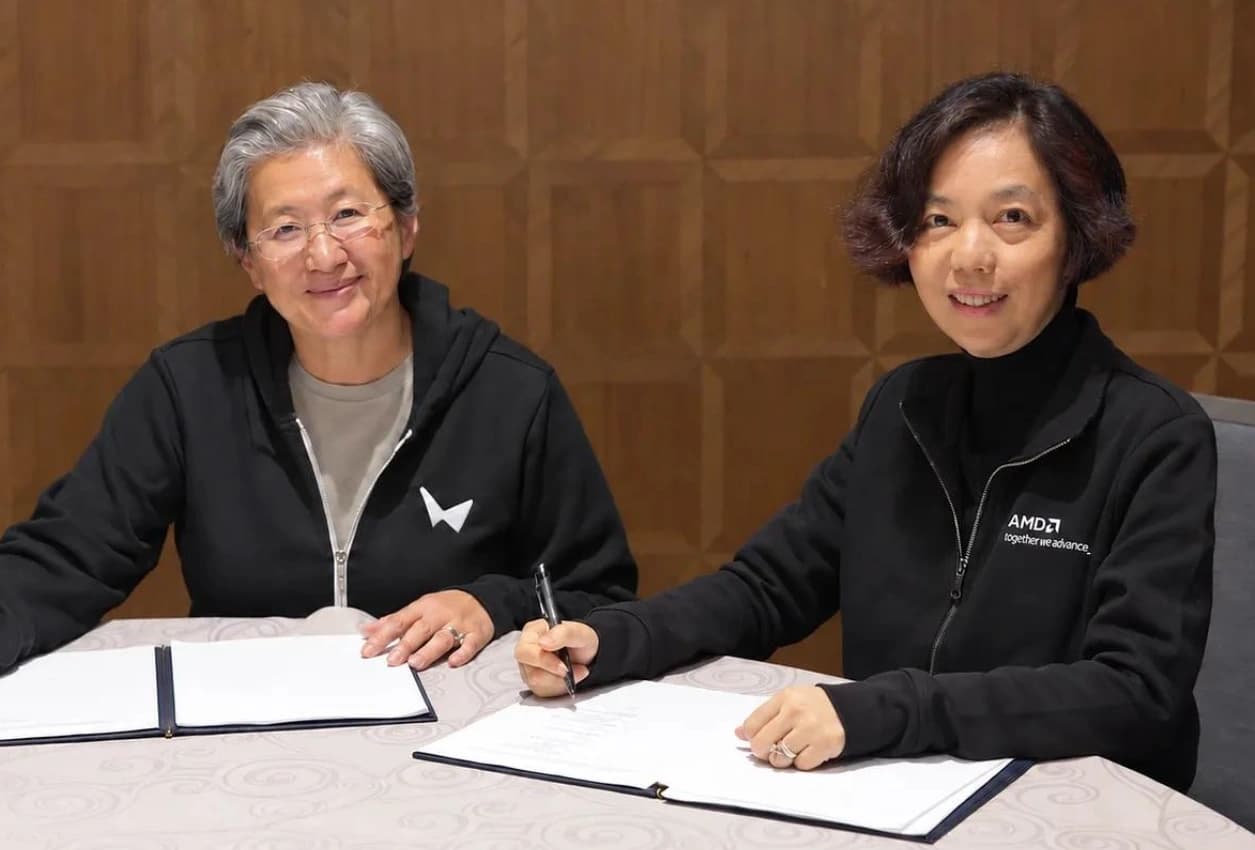
- AMD is acquiring World Labs in an all-stock deal valued at approximately $8.2 billion, with founder Fei-Fei Li joining as EVP and Chief Scientist reporting directly to Lisa Su.
- The deal targets spatial-intelligence models — 3D environment generation, reconstruction, and simulation — workloads that demand fundamentally different compute profiles than today's dominant LLM training runs.
- Traders should watch the regulatory timeline, with AMD targeting a close by end of 2026, against a backdrop of accelerating DOJ antitrust scrutiny across the chip sector.
AMD is down 2.03% in Monday premarket trading, but the real story isn't today's tape — it's the $8.2 billion all-stock bet Lisa Su just made on the woman who helped start the modern AI era. AMD's acquisition of World Labs, expected to close before year-end, will bring Dr. Fei-Fei Li onto AMD's executive team as Chief Scientist, inserting one of the field's most credentialed researchers directly into the company's strategic decision-making at a moment when the next wave of AI workloads is beginning to take shape.
The Strategic Logic Behind Spatial AI
World Labs was founded in 2024 and built around a deceptively simple premise: the next frontier of AI isn't just understanding language or generating images — it's understanding and simulating physical space. The company's spatial-intelligence models can generate, reconstruct, and simulate interactive 3D environments from text, image, and video inputs. That capability sits at the intersection of robotics, autonomous systems, physical simulation, and next-generation gaming — industries collectively representing hundreds of billions in addressable compute spend that isn't yet meaningfully reflected in AMD's revenue mix.
This isn't AMD buying market share. It's AMD buying a research capability and a scientific brand that rivals Nvidia's own talent density. Nvidia has spent years cultivating its CUDA software moat and its relationships with AI research labs. AMD has competitive silicon — the MI300X and its successors are real alternatives for inference workloads — but it has lacked the kind of deep, credible AI research identity that attracts frontier model developers before they've decided which hardware to build on. Fei-Fei Li, who co-led the ImageNet project that effectively launched the deep learning revolution, is one of the few figures in the field who can shift that perception.
The deal structure matters as much as the rationale. An all-stock transaction at $8.2 billion signals AMD's confidence in its own equity currency — AMD shares are up roughly 40% over the past 12 months despite this morning's pullback — and avoids a cash drain at a moment when the company is simultaneously navigating supply constraints that Lisa Su publicly acknowledged last week. Su stated directly that demand for AMD CPUs is "even higher than our supply," and that the company is planning to "substantially increase supply in 2027." Spending $8.2 billion in cash on a research firm while rationing silicon would have sent the wrong signal to both customers and investors.
What $8.2 Billion Actually Buys
At $8.2 billion for a company founded in 2024, AMD is paying almost entirely for talent, intellectual property, and optionality — not revenue. World Labs has not disclosed commercial revenue figures, and the company's products are still in the research-to-productization pipeline. That's a premium AMD is explicitly choosing to pay, and it warrants scrutiny.
What the deal does buy concretely: a research team led by Li and her co-founders, a body of work in spatial-intelligence modeling that no other chip company currently owns, and a seat at the table when the robotics and physical-AI software ecosystem begins to standardize around training and inference infrastructure. The robotics market alone — from warehouse automation to humanoid robots — is expected to require purpose-built simulation environments for training that look nothing like current LLM pipelines. If World Labs' spatial models become a foundation layer for that training process, AMD's hardware becomes the natural substrate.
The comparison to Nvidia's acquisition strategy is instructive. Nvidia paid $40 million for Mellanox in 2020 — a deal that looked expensive at the time and turned out to be the infrastructure backbone of its AI networking dominance. AMD is betting that World Labs occupies a similarly foundational position in physical AI's infrastructure stack, just five years earlier in the cycle. Whether that analogy holds depends entirely on whether spatial-intelligence models become a standard component of next-generation AI pipelines — or remain a research curiosity.
There is also a competitive-intelligence dimension. Fei-Fei Li has deep relationships across academia and the research community. Her presence inside AMD changes how AI researchers evaluate the company as a hardware partner. That soft power — the ability to attract PhD talent, collaborative research, and early-stage model developers — is genuinely difficult to price but potentially more durable than any single product launch.
What Traders Watch Next
The immediate trading question is whether AMD's premarket weakness — off 2.03% alongside a broader chip sector selloff, with SOXX down 0.69% and NVDA off 0.52% — reflects the market pricing in deal dilution or simply sector-wide rotation ahead of a catalyst-heavy week. The all-stock structure means AMD shareholders are absorbing dilution now in exchange for long-term research optionality, and in a risk-off tape, that's the kind of trade the market tends to punish first and evaluate later.
Regulatory approval is the operational gatekeeper. With the DOJ's antitrust probe into Nvidia escalating to subpoena stage and the FTC's Microsoft investigation widening, no large tech deal closes on autopilot in late 2026. AMD has guided for a close by December 31, which is achievable if regulators treat this as a talent acquisition rather than a competitive foreclosure concern — which it almost certainly is, given World Labs' pre-revenue status and narrow market footprint.
Supply constraints remain AMD's most immediate operational challenge regardless of the acquisition. Su's confirmation that HBM remains supply-constrained, combined with Micron CEO Sanjay Mehrotra's disclosure that more than 75% of the company's 2027 HBM output is already committed, means AMD's ability to scale AI accelerator shipments next year is bounded by packaging and memory availability, not chip design. World Labs doesn't solve that problem. What it potentially solves is the question of where AMD sits in the AI ecosystem hierarchy once the supply crunch eases and the market begins rewarding software moats as aggressively as it currently rewards silicon.
The specific catalyst to watch: TSMC's Q3 earnings on Thursday, October 15. TSMC's guidance — which AMD relies on for advanced node production, including 3nm — will either validate or complicate AMD's 2027 supply expansion narrative. TSMC raised its full-year revenue growth guidance to more than 30% after Q1; another upward revision would signal that advanced node capacity is expanding fast enough to support AMD's supply ramp. A cautious guide would tighten the timeline. Watch for AMD management commentary on the World Labs deal structure and integration timeline when they next appear publicly — the Street will want to know whether Fei-Fei Li's research mandate comes with hard milestones or open-ended exploration.
The Weekly Investor
Daily market analysis for active traders. Free.