AMD Reports Tomorrow: $13.09B Bar, 62% EPS Growth
AMD reports Q3 2026 earnings Nov. 3 after close. Wall Street expects $13.09B revenue and $1.95 EPS. Here's what traders need to watch.
Key Points
- AMD must deliver $13.09B in Q3 revenue and $1.95 adjusted EPS tomorrow — a 62% year-over-year earnings growth bar — to stop a stock that has already shed 23.20% from its 2026 peak.
- The quarter lives and dies on Instinct GPU revenue and forward guidance on the MI350 ramp, which faces direct pressure from Nvidia's H200 and B200 in enterprise data centers.
- The real tell comes from Q4 guidance: Wall Street is already pricing $16.29B and $2.68 EPS — miss that number and the sector selloff accelerates ahead of Nvidia's November 17 print.
AMD enters its most consequential earnings call of the year wounded, beaten down, and carrying a 62% profit growth burden. The stock closed the week at a level 23.20% off its 2026 peak, dragged lower by Intel's catastrophic October 30 guidance shock — Intel fell 28.58% that session — in a single-day chip wipeout that erased roughly $1 trillion in sector market cap. AMD dropped 10.88% in that session alone. Tomorrow after the bell, AMD has one shot to reset the narrative for the entire semiconductor complex before Nvidia's November 17 earnings arrive.
The Numbers That Actually Matter
Wall Street is not subtle about what it needs: $13.09 billion in Q3 revenue, $1.95 in adjusted EPS, and a gross margin of approximately 56%. The revenue figure implies 41% year-over-year growth and lands almost exactly at AMD's own Q3 guidance midpoint of $13.0 billion — a rare instance where the company and the Street are essentially aligned. That alignment cuts both ways. There is no sandbagging buffer. AMD guided this number; AMD owns it.
The EPS story is where the real pressure sits. $1.95 adjusted EPS would represent 62.5% growth from $1.20 in Q3 2025. That is an aggressive bar in any macro environment, let alone one where the SOXX is technically broken and AI stocks have collectively shed roughly $5 trillion in market value since early October. AMD has beaten EPS estimates in each of the last three consecutive quarters — by 9.6% in Q1 and 7.1% in Q2 — which gives the company a credible track record of outperformance. But Q3's consensus has already absorbed that history. The beat threshold is baked in.
Gross margin is the sleeper metric. AMD guided approximately 56% adjusted gross margin for Q3, up 200 basis points from 54% in the year-ago period. Any compression below 55% will be read as a sign that Instinct GPU pricing is under pressure from Nvidia's dominant positioning in the H200 and B200 product lines — a structural negative that no revenue beat can fully paper over. Watch the gross margin line before you watch the top line.
The Instinct GPU Question
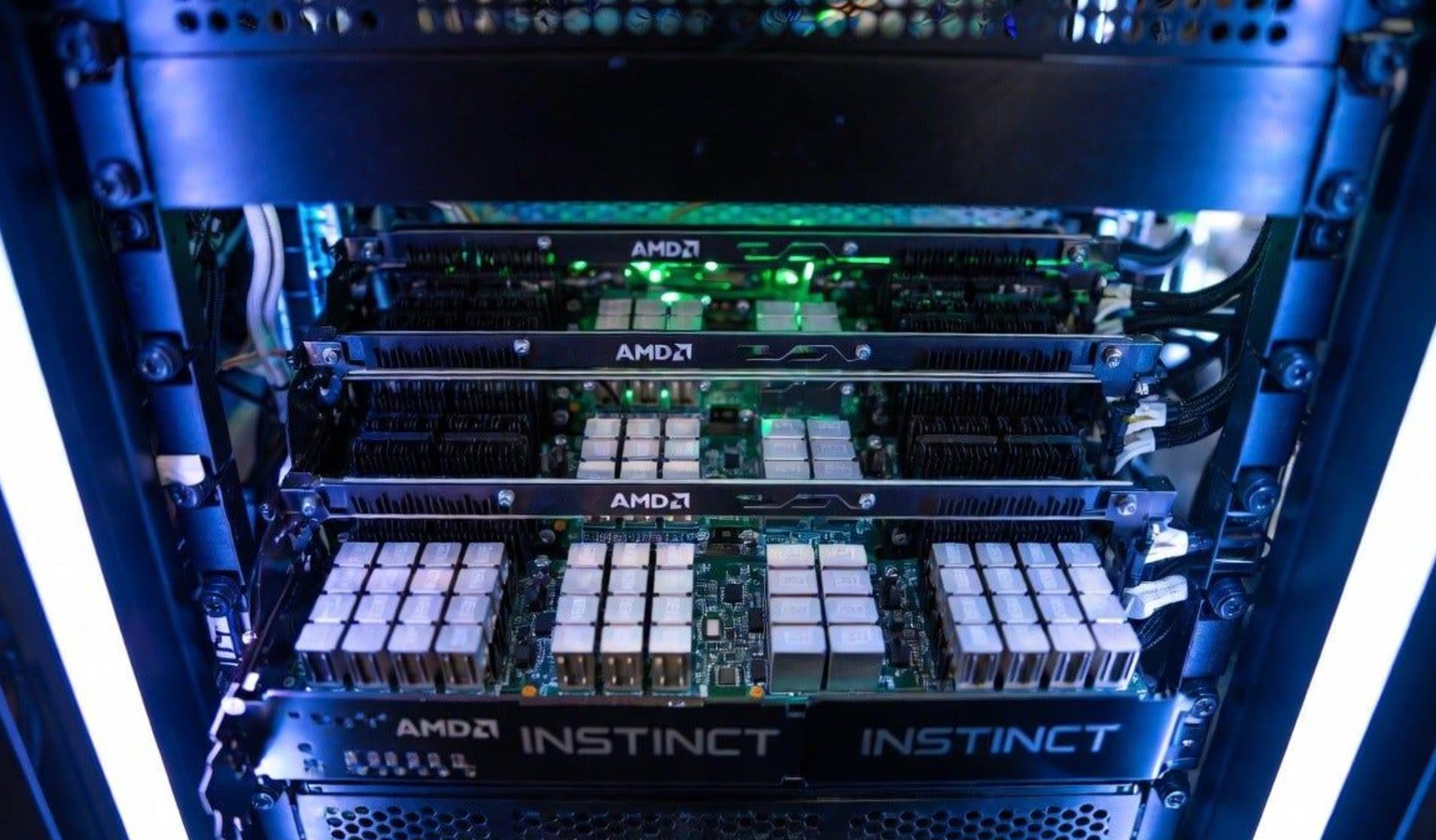
The entire bull thesis for AMD in 2026 runs through the Instinct AI accelerator franchise, and specifically through one unanswered question: is MI350 customer ramp accelerating, or is it stalling against Nvidia's entrenched hyperscaler relationships? AMD has not provided a standalone revenue breakout for Instinct GPU sales — a disclosure gap that has frustrated institutional investors and will likely dominate the Q&A on tomorrow's call.
What is knowable is the competitive context. Nvidia's H200 and B200 chips remain the default choice for the largest AI training workloads at Amazon, Google, Microsoft, and Meta. AMD has made genuine inroads in inference and in AI training at cost-sensitive buyers, and the EPYC server processor franchise is unambiguously strong — EPYC has taken meaningful share from Intel across cloud and enterprise over the past 18 months, and Intel's October guidance shock, which cited deteriorating data center demand, did not appear to implicate AMD's EPYC business in the same way. AMD and Intel are serving different customer profiles at this point.
But Instinct is the growth vector the market is paying for. EPYC is real, profitable, and growing — it will anchor the quarter. Instinct is the story that justifies the multiple. If AMD's management declines to quantify Instinct revenue in the prepared remarks, expect analysts to extract the number in Q&A, and expect the stock to move on whatever color they provide. A figure above $4 billion for the quarter would be constructive. Commentary suggesting MI350 is tracking ahead of the MI300X ramp at this stage of its cycle would be the single most bullish thing AMD could say tomorrow night.
What Traders Watch Next
Q4 guidance is where the earnings call either rehabilitates or extends the damage done to AMD shares in October. Wall Street is already modeling $16.29 billion in Q4 revenue and $2.68 in adjusted EPS — sequential growth of approximately 24.5% on the top line. That is an enormous ask for a single quarter, and it assumes Instinct GPU shipments accelerate materially into the holiday and enterprise budget flush period. AMD's management will need to either confirm that trajectory or absorb a second wave of selling on top of the October damage.
The sector read-through matters as much as the AMD-specific outcome. Nvidia reports Q3 results on November 17, and sentiment heading into that print will be shaped almost entirely by what AMD says tomorrow. A strong AMD quarter with confident forward guidance — particularly any commentary on AI accelerator backlog depth or hyperscaler purchase commitments — would stabilize the SOXX and give Nvidia bulls something to trade against into mid-November. A miss, or a cautious guide, reopens the $5 trillion AI selloff narrative and puts Nvidia at risk of testing below the $200 level before it even reports.
The specific level to track: AMD's 200-day moving average, which currently sits near the stock's post-October lows. A post-earnings gap below that level on a guidance miss would be technically decisive and could accelerate forced selling from momentum funds that have held through the October drawdown. Conversely, a beat-and-raise that pushes AMD back toward the $165–$170 range would constitute a meaningful technical recovery and shift the conversation from sector breakdown to sector rotation opportunity. The November 3 print, after the close, is the most important single data point for chip traders before Nvidia's November 17 report.
The Weekly Investor
Daily market analysis for active traders. Free.