AMD Data Center Revenue Doubles to $8.5B, Stock Surges
AMD's data center segment hit a record $8.5B in Q3, up 97% YoY — the relief valve the semiconductor sector needed after a $3.7T wipeout.
Key Points
- AMD's data center segment posted record Q3 revenue of $8.5B, up 97% year-over-year — its fourth consecutive quarter beating both top and bottom consensus estimates.
- The blowout print is a direct relief valve for a sector that shed roughly $3.7 trillion in market cap since October 6, with AMD shares up 8.3% after hours and pre-market quoted at $488.18, +4.57%.
- Watch the $500 level on AMD and whether the Philadelphia Semiconductor Index can sustain its near-3% Tuesday surge through the week; Super Micro's $72–$82B full-year guide is the next confirming data point.
AMD's data center business just printed the most important number in semiconductors this earnings season: $8.5 billion in Q3 revenue, up 97% year-over-year, nearly double what the segment generated twelve months ago and now representing close to two-thirds of the entire company's top line. The stock surged 8.3% after hours and was quoted at $488.18 in pre-market Wednesday, extending Tuesday's already-strong 4.57% session gain — the latest leg of a sector-wide comeback that pushed the Philadelphia Semiconductor Index up nearly 3% in a single session.
The Numbers Behind the Relief Rally
The magnitude of AMD's beat cannot be separated from the context it arrives in. Chip and memory stocks had shed approximately $3.7 trillion in collective market cap since October 6, a drawdown that made Tuesday's sector reversal one of the most consequential single-session recoveries of the year. AMD's Q3 print landed as the proximate catalyst, but the breadth of the move — Nvidia up 3.07% to $208.26, Intel up 3.96% to $62.34, TSMC's ADR up 2.03% to $406.62 — signals that the market had been waiting for hard evidence that AI infrastructure spending hadn't stalled. AMD provided it.
This is AMD's fourth consecutive quarter of beating analyst estimates on both revenue and earnings per share, a streak that has now stretched long enough to force a reappraisal of the company's standing in the AI accelerator hierarchy. CEO Lisa Su has consistently framed the data center ramp as durable rather than cyclical, and Q3's numbers make that argument harder to dismiss. Data center revenue at $8.5 billion isn't a rounding error or a one-quarter channel-fill event — it is a structural reorientation of AMD's business model, executed in roughly six quarters from a standing start in AI training and inference silicon.
The comparison point that matters most: Nvidia reported data center revenue of $30.8 billion in its most recent comparable quarter, meaning AMD is now running at roughly 28 cents of data center revenue for every dollar Nvidia generates. Twelve months ago that ratio was closer to 15 cents. The gap is still enormous, but the trajectory is what traders are pricing — and AMD's direction of travel is unambiguous.
The Intel Overhang That Almost Buried the Quarter
The setup coming into AMD's print was deeply unfavorable, and understanding why makes the magnitude of the beat more significant. Intel guided Q4 2026 revenue to $15–$16 billion — a range that spooked the entire semiconductor complex, dragged AMD lower for two consecutive sessions, and deepened the broader $3.7 trillion sector drawdown. The Intel news landed like a demand-destruction signal, raising the question of whether hyperscaler AI capex was beginning to plateau.
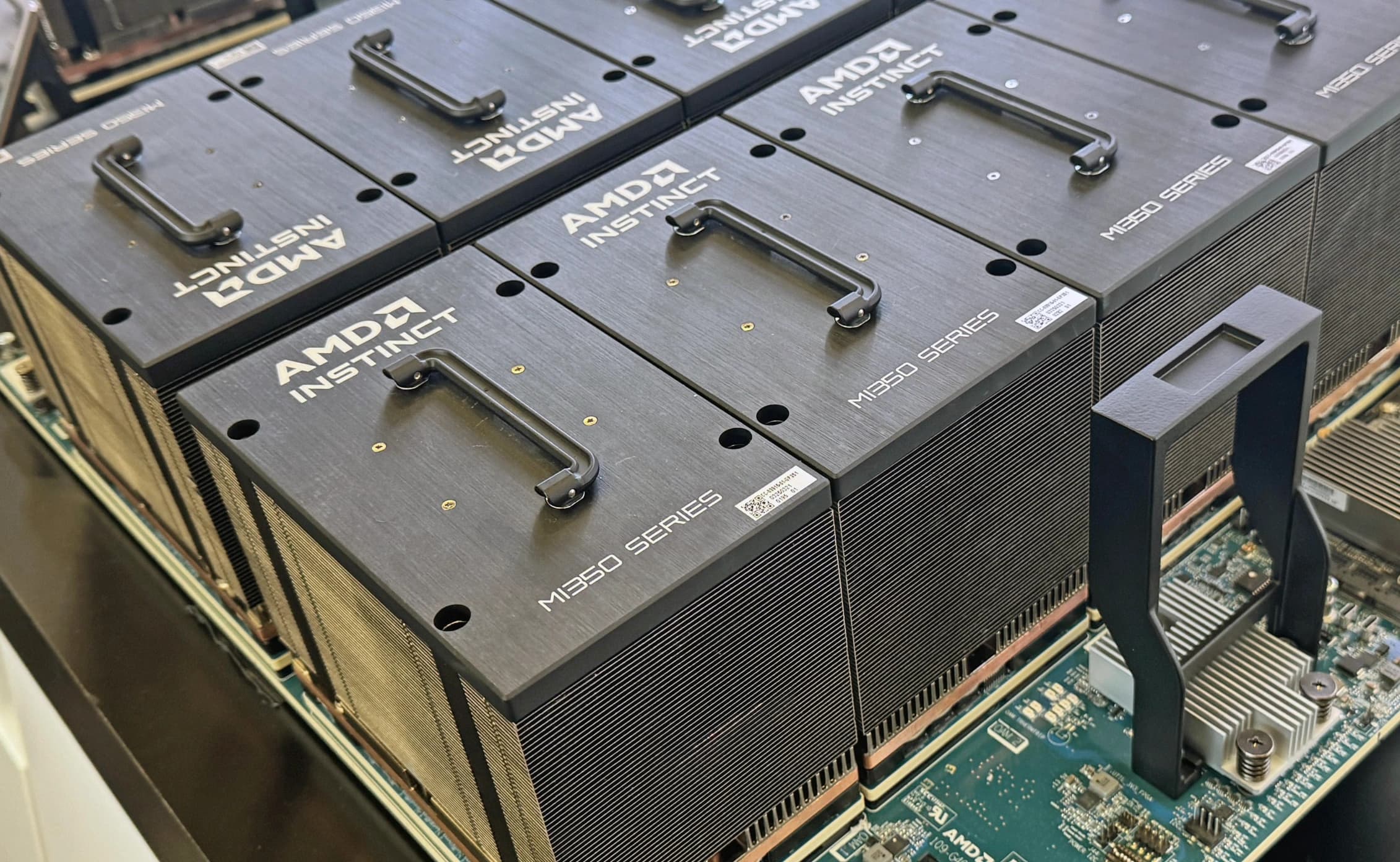
AMD's data center print essentially answered that question with a no. The divergence between Intel and AMD is now structural, not cyclical: Intel's revenue struggles are concentrated in legacy server CPUs and manufacturing execution risk, while AMD's data center growth is overwhelmingly driven by MI300X GPU accelerator shipments into AI training and inference workloads. These are different demand pools. Intel's Q4 guidance reflects its own competitive positioning, not a slowdown in AI infrastructure spending at the hyperscaler level.
That distinction matters for how traders position across the semiconductor supply chain. TSMC, which manufactures AMD's leading-edge silicon, reported a record $46.7 billion in Q3 revenue last week, up 50% year-over-year — a corroborating data point that wafer demand from AMD and Nvidia is accelerating, not decelerating. TSMC's Taylor, Texas facility is now breaking ground this month on a 250,000-square-meter footprint, with the majority of planned HBM base-die capacity earmarked for AMD — a supply commitment that suggests TSMC sees AMD's data center ramp as multi-year, not episodic.
What Traders Watch Next
The immediate technical question is whether AMD can hold and extend through the $500 level — a threshold that would represent a fresh leg higher after the stock had pulled back sharply from earlier 2026 highs during the sector-wide drawdown. The 8.3% after-hours surge and pre-market extension to $488.18 position AMD within striking distance, and momentum traders will be watching whether institutional buyers step in on the open or whether profit-taking from shorter-term holders caps the move.
Beyond AMD's own chart, the most important confirming data point is Super Micro. SMCI posted fiscal Q1 revenue of $19.95 billion — up 298% year-over-year against a $16.39 billion consensus — and lifted its full-year FY27 guidance to $72–$82 billion. Super Micro is the most direct proxy for Nvidia-powered AI server shipments reaching end customers, and its guidance implies that the AI infrastructure buildout is not only intact but accelerating into calendar 2027. The stock's reaction to that print, combined with AMD's data center numbers, sets the narrative for the rest of the Q3 earnings cycle in AI hardware.
One structural risk the AMD rally doesn't erase: the off-balance-sheet AI debt load at five major U.S. tech giants has nearly doubled in six months to $3.2 trillion, according to reporting by Nikkei. That figure represents the financial obligation underpinning the hyperscaler capex cycle that is driving AMD's data center revenue. As long as those commitments hold, AMD's growth trajectory remains intact. If credit conditions tighten or hyperscalers begin capital discipline reviews in calendar Q1 2027 — historically the period when annual capex plans are set — that $3.2 trillion overhang becomes the most important macro variable in the entire AI hardware trade. The specific date to watch: Micron's December 9 buyback restriction expiration under the CHIPS Act, which will serve as a secondary read on semiconductor sector confidence heading into year-end.
The Weekly Investor
Daily market analysis for active traders. Free.